Examining the Effectiveness of Various Waste Diversion Programs in Reducing Landfill Impact
By BKThemes
How Waste Diversion Programs Cut Landfill Impact for Multi‑Location Businesses
Waste diversion covers practical steps—recycling, composting, reuse, and energy recovery—that keep materials out of landfills. Those steps lower landfill volume, reduce greenhouse gas emissions, and shrink long‑term liabilities for enterprise operators. This article looks at how diversion programs perform at scale for organizations with 50–5,000 locations, explains the environmental and financial drivers, and lays out straightforward measurement frameworks to track progress. You’ll learn which programs cut the most landfill per ton, how to prioritize streams by ROI, and which KPIs align with certification paths like zero waste. Our analysis focuses on data‑driven rollout, centralized compliance and reporting, and the cross‑jurisdictional realities large portfolios face. Each H2 addresses a clear decision area—environmental and cost impacts, program comparisons, implementation, measurement, trends, and case studies —so facilities teams, sustainability managers, and procurement can align strategy with measurable diversion goals.
What environmental and financial impacts do landfills create for businesses?
Landfills create both environmental burdens and direct cost pressure: anaerobic decomposition emits methane, leachate risks local water supplies, and tipping fees plus transport raise operating expenses. Because methane is potent and increasingly regulated, landfill tonnage shows up as a Scope 3 emissions issue in corporate GHG inventories. Local community impacts can also create reputational and compliance liabilities. For multi‑location operators, relatively small per‑site tonnages add up quickly across hundreds or thousands of sites. Understanding these drivers helps prioritize diversion programs that lower both emissions and recurring waste spend. The subsections below quantify methane risk and tipping‑fee trends to show why diversion delivers measurable value and which mitigation steps administrators should consider next.
How do methane emissions from landfills influence climate goals?
Methane from landfills forms when organic waste decomposes without oxygen and is a powerful greenhouse gas—about 84–87 times more warming than CO2 over 20 years, per the IPCC Sixth Assessment Report. That makes diverting organics from landfills one of the most effective near‑term climate actions. For multi‑location businesses, cutting landfill organics produces measurable Scope 3 improvements and can accelerate corporate net‑zero timelines. Accurate quantification combines diverted‑organics metrics with emissions factors, which naturally ties into the economics of tipping fees and the cost‑benefit of organics programs at scale.
How are landfill tipping fees changing for multi‑site operators?
Tipping fees have generally risen across many North American markets over the last decade due to capacity limits, tighter regulations, and local market forces—driving up per‑ton disposal costs. For multi‑site operators, even modest fee increases compound across hundreds of locations, creating material budget variability. Invoice auditing and vendor consolidation are primary levers to control spend: audits reveal billing errors, and consolidation creates negotiating power to secure better rates. Understanding fee trends helps diversion and motivates the operational changes described in the next sections.
Which diversion programs deliver the biggest landfill reductions?
High‑impact diversion programs focus on the largest streams and balance operational feasibility with diversion potential. Typical categories include commercial recycling, organics composting/AD, waste‑to‑energy, reuse/refurbish, e‑waste recycling, and hazardous diversion. Each works by capturing recoverable materials at source, routing organics for biological processing, or converting residuals into energy. The optimal mix depends on material makeup, local infrastructure, and regulation. Below, we compare the main program types, outline typical diversion and cost impacts, and offer enterprise suitability guidance. After the comparison, we discuss scalable implementation and managed services that deliver consistent, auditable outcomes.
Ready to reduce costs and improve diversion across multiple sites? National Waste Associates helps multi‑location businesses cut waste spend, stay compliant, and meet sustainability targets—reach out to learn more about strategic waste diversion.
The table below compares major diversion program types and their typical enterprise fit.
| Program Type | Typical Diversion Impact (%) | Typical Cost Impact | Ideal Use Cases |
|---|---|---|---|
| Commercial recycling | 10–40 | Can reduce net disposal costs via commodity recovery; moderate implementation cost | Retail, office parks, distribution centers |
| Food waste composting/AD | 30–70 | Higher collection cost, but large tipping savings where organics compose a large share | Restaurants, grocery chains, food service |
| Waste-to-Energy (WtE) | 40–80 | Can offset energy costs; capital/permit intensive; variable public acceptance | Mixed commercial/industrial streams where energy recovery viable |
| E-waste & hazardous diversion | 80–95 (stream-specific) | Often cost-neutral to positive when value recovery is possible; regulatory compliance required | Electronics retailers, healthcare, and manufacturing |
| Reuse & refurbish programs | Varies (process-specific) | Potential revenue from resale requires reverse logistics | Retail returns, corporate asset disposition |
This comparison highlights that organics and targeted specialty‑stream programs often deliver the largest per‑ton landfill reductions for commercial portfolios, while recycling and reuse remain essential complementary strategies.
How does commercial recycling cut landfill volume and costs?
Commercial recycling diverts cardboard, paper, metals, plastics, and glass to material recovery facilities (MRFs) where commodities are sorted and sold. Success combines source separation, staff training, proper bin infrastructure, and dependable hauling contracts. When contamination is controlled, diversion rates and commodity revenue improve, lowering net waste costs. For enterprises, operational changes include standardized labeling, site‑level training, and aligned vendor specs to keep material quality consistent across regions. Managing contamination and volatile commodity markets is an ongoing operational challenge—and one reason organics programs are often prioritized.
What role does food waste composting play in sustainable programs?
Food‑waste composting and anaerobic digestion divert high‑biodegradable streams that would otherwise produce landfill methane, and they typically yield the highest marginal climate benefit per ton. Organics programs can use centralized collection to composting/AD facilities or on‑site systems like in‑vessel units. Feasibility hinges on collection cadence, contamination controls, and local processing capacity. Multi‑site rollouts usually start with pilots to refine bin layouts and staff routines, then scale with reliable hauler partnerships and contract terms to ensure consistent service across jurisdictions. Successful organics capture often leads to energy recovery opportunities and raises permitting considerations.
How do waste‑to‑energy solutions reduce landfill reliance?
Waste‑to‑energy (WtE) options—from incineration with energy recovery to anaerobic digestion—reduce landfill tonnage by converting residuals into electricity, heat, or biogas. These technologies can significantly lower disposal volumes and provide energy offsets, but they come with emissions, permitting, and public‑acceptance trade‑offs businesses must weigh. WtE suitability is regional: where landfill capacity is constrained, and facilities exist, WtE can complement recycling and organics programs. Balancing environmental tradeoffs and regulatory compliance makes careful handling of sensitive streams like e‑waste and hazardous materials essential. Waste-to-energy is important
What are effective e‑waste and hazardous diversion strategies for corporations?
E‑waste and hazardous streams need certified carriers, a documented chain of custody, and specialized recycling or refurbishment to avoid landfill disposal. Effective strategies focus on asset recovery, safe dismantling, and accurate regulatory reporting. Corporations should work with certified vendors, maintain manifests, and explore value recovery through resale or component reclamation. Centralized policies and procurement standards reduce risk across jurisdictions by standardizing handling and vendor qualifications. Properly managed, these specialty programs prevent landfill disposal and lower legal and environmental liabilities—key elements of enterprise‑scale managed services.
How does National Waste Associates optimize diversion for multi‑site businesses?
Curious how to translate diversion plans into consistent, measurable results across hundreds of sites? NWA helps multi‑location businesses reduce costs, tighten compliance, and scale sustainable programs—contact us to discuss an audit or pilot.
National Waste Associates (NWA) turns program choices into enterprise‑scale operations: we consolidate vendor relationships, audit invoices, and deploy data‑driven reporting to standardize diversion across 50–5,000 locations. NWA’s matches site needs to utilize regional capacity using a database of 3,500+ haulers, identifies up to 20% in collection savings through invoice and service audits, and provide centralized compliance to manage multi‑jurisdictional requirements. Our NWA360 client portal brings site‑level diversion and cost data into one dashboard to drive continuous optimization and document progress toward certification goals.
The following table maps core NWA capabilities to expected outcomes and sample metrics.
| Capability | NWA Capability | Expected Outcome | Example Metric |
|---|---|---|---|
| Cost control | Invoice auditing & optimization | Reduced waste spend | Up to 20% cost reduction on collection services |
| Vendor management | Network of 3,500 haulers | Better service coverage & rates | Consolidated contracts across regions |
| Reporting | NWA360 centralized analytics | Data-driven diversion improvements | Diversion rate, cost per ton by site |
| Compliance | In-house compliance manager | Reduced regulatory risk | Documented manifests, permits across jurisdictions |
This capability map shows how managed services translate program plans into measurable outcomes and sets up the next details on compliance, pilots, and certification.
What are the advantages of consolidated waste management across 50–5,000 locations?
Consolidated waste management reduces administrative burden by centralizing contracts, invoicing, and vendor oversight, letting enterprises standardize service levels and negotiate better pricing. Operational wins include fewer contacts, faster issue resolution, and consistent site procedures that cut contamination and lift diversion. Financially, consolidation increases leverage for improved tipping and haul rates and eliminates redundant administrative tasks across regions. These benefits pave the way for targeted savings methods—invoice audits, test‑and‑scale pilot, sand analytics—which we describe next. waste-to-energy
How does NWA deliver cost reduction and stream optimization?
NWA finds savings through systematic invoice audits, service‑level reviews, and focused pilots that expose unnecessary services, overbilling, or misapplied rates. Optimization starts with site‑level waste audits to quantify stream composition, then pilots test new bin setups, collection cadence, or organics routing before scaling proven approaches across hundreds of sites. Ongoing monitoring—cost‑per‑ton, contamination rates, and other KPIs—drives iterative improvements and preserves achieved savings. These operational levers combine to deliver immediate and sustained financial and diversion gains.
How does NWA manage regulatory compliance across North America?
NWA’s centralized compliance team tracks multi‑state and provincial requirements to ensure manifests, permits, and chain‑of‑custody documentation meet local standards across a client’s portfolio. Centralized oversight reduces risk through harmonized templates, validated vendor certification, and a single compliance contact for regulators and internal teams. Local partners and certified haulers handle site execution while NWA maintains records and coordinates remediation. That coordinated approach supports scalable diversion programs and underpins certification pathways such as zero waste.
What does the path to zero waste certification look like with NWA?
The certification path follows a phased roadmap: baseline audits to establish diversion, program design for prioritized streams, pilot tests to validate tactics, scale‑up with standardized procedures, and documentation for verification. NWA supports each phase with audits, vendor coordination, NWA360 reporting to evidence diversion metrics, and compliance records aligned with certifier criteria. Reaching >90% diversion typically requires iterative work on contamination control, organics capture, and specialty‑stream handling, plus centralized reporting to demonstrate outcomes for certifying bodies.
How should businesses measure success for diversion programs?
Measuring success needs a defined KPI set, consistent methods, and a regular reporting cadence so progress is auditable and actionable. Core metrics include diversion rate, contamination rate, kilograms diverted per site, and cost per ton. Accurate measurement pairs periodic waste audits, scale‑ticket reconciliation, and centralized analytics to normalize data across sites and jurisdictions. Benchmarks for pilot and scale phases help stakeholders track expected progress and prioritize investments that deliver the most diversion per dollar. The following subsections define core KPIs, outline NWA360 reporting, and explain the value of very high diversion rates.
Below is a practical KPI table mapping metrics to measurement methods and business value. Best practices to reduce gas station and convenience store waste.
| Metric | Measurement Method | Frequency | Business Value |
|---|---|---|---|
| Diversion rate | (Diverted tonnage / Total tonnage) × 100 | Monthly/Quarterly | Tracks landfill avoidance progress |
| Contamination rate | Material inspectors/audit samples | Quarterly | Improves material quality and commodity revenue |
| Cost per ton | Total waste spent / total tons | Monthly | Financial benchmark for program ROI |
| kg diverted/site | Site-level weigh data | Monthly | Identifies high-potential sites for scaling |
Which KPIs best track diversion effectiveness?
Primary KPIs are diversion rate (diverted tonnage ÷ total waste), contamination rate (share of non‑target materials), cost per ton (waste spend ÷ tons handled), and per‑site kilograms diverted to prioritize interventions. Calculating these requires consistent scale tickets, periodic composition audit, and normalized reporting across locations to make valid comparisons. Benchmarks vary by industry and maturity, but teams commonly monitor pilot progress monthly and scale‑phase performance quarterly before a wide rollout. Clear KPI definitions align leadership, operations, and finance around shared sustainability and cost goals. Business cost savings
How does NWA360 reporting enable data‑driven waste management?
NWA360 centralizes site‑level diversion, cost, and compliance data into dashboards and reports so stakeholders can compare performance, spot outliers, and prioritize interventions across hundreds or thousands of locations. Typical outputs include diversion‑rate trends, invoice reconciliation summaries, cost‑per‑ton by region, and contamination alerts—each supporting faster decisions and certification evidence. Analytics also reveal high‑opportunity sites for pilots and verify that changes deliver expected savings and diversion gains. That reporting then fuels continuous improvement and rapid scaling of what works.
What’s the business value of achieving >90% diversion?
Hitting north of 90% diversion brings clear environmental, financial, and strategic benefits: it sharply reduces landfill tonnage and methane emissions, lowers disposal spend through reduced tipping and possible material revenue, and strengthens brand positioning with customers and regulators. High diversion also simplifies procurement by reducing demand for virgin materials and supports circular initiatives like takeback and reuse. Documented, high‑diversion results support certifications and public commitments while driving ongoing operational excellence across a portfolio.
What industry trends are shaping corporate waste diversion?
Through 2025, we see accelerating regulatory pressure for source separation, broader tech adoption for tracking and contamination control, and stronger alignment with circular‑economy principles. These shifts change program design and scale. Regulatory momentum pushes businesses toward standardized source separation and documentation, increasing the need for centralized compliance and consistent site procedures. Technology—sensor bins, route optimization, and improved MRF sortation—boosts capture and cuts contamination. Knowing these trends helps enterprises choose future‑proof strategies as policy and markets evolve.
How are mandatory source separation laws changing business practices?
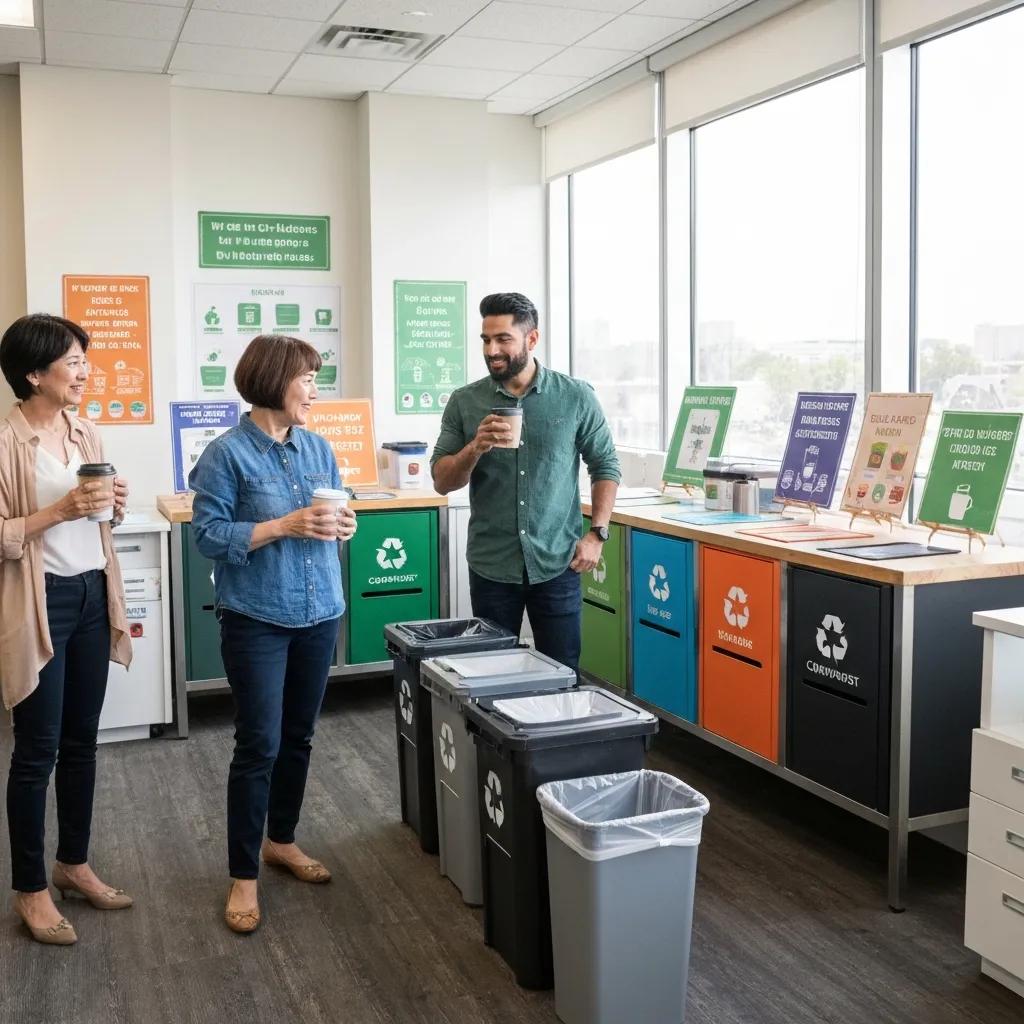
Mandatory source separation requires businesses to sort certain materials on site, prompting operational changes like new bin layouts, staff training, clearer signage, and updated procurement specs. For multi‑location operators, these mandates raise the value of centralized compliance and standardized procedures to ensure consistent adherence. Typical responses include rolling out training, updating vendor contracts, and using analytics to demonstrate compliance. These shifts tie regulatory change directly to measurable program outcomes and increase demand for managed services and enabling technology.
Which technologies are improving diversion program performance?
Key technologies include advanced sortation at MRFs, sensor‑based fill‑level monitoring to optimize pickups, contamination detection systems, and analytics platforms that merge scale tickets with invoice data. These tools cut operational costs by reducing unnecessary trips, improving material quality at capture, and enabling predictive maintenance of on‑site assets. When sensor data feeds centralized reporting, sustainability teams can target interventions where incremental diversion is highest. As adoption grows, technology makes it easier to scale consistent programs across disparate sites.
How do circular economy principles change sustainable waste management?
Circular economy thinking—design for reuse, extended producer responsibility, and life‑extension—shifts strategy from disposal toward material retention. Businesses can adopt circular approaches through procurement policies favoring recyclable or reusable packaging, takeback programs, and partnerships to reclaim value from returns. For multi‑site enterprises, circularity reduces net waste over time and aligns procurement, operations, and sustainability goals. Those practices also boost long‑term cost resilience against material‑supply swings.
What do real‑world multi‑location diversion programs look like?
Case studies show how enterprises combine program selection, pilots, vendor consolidation, reporting, and compliance to reach measurable diversion and cost outcomes. Successful rollouts start with baseline audits, run focused pilots to validate recycling, organic, and specialty‑stream handling, then scale with centralized vendor management and reporting. The H3 case narratives below summarize common pathways and measurable results that other organizations can replicate.
How did a national retailer reach ~90% diversion?
A national retailer began with a baseline waste audit that identified dominant streams—cardboard, bakery food waste, and soft plastics—and piloted source‑separation workflows in representative regions. Interventions included standardized store bin layouts, staff training protocols, dedicated organics pickup, and negotiated hauler contracts via vendor consolidation. After pilot validation, the retailer scaled the program and used centralized reporting to monitor diversion and contamination, ultimately documenting a diversion rate near 90% for the targeted streams. The phased approach and strict reporting discipline underline the value of pilots and repeatable procedures for high‑performance diversion.
What cost and environmental outcomes have NWA clients seen?
NWA’s managed programs combine invoice auditing and vendor consolidation with data‑driven optimization and compliance. Typical client outcomes include up to 20% savings on collection services through auditing and optimization, documented diversion improvements at or above 90% for clients pursuing zero waste, and reduced landfill tonnage that lowers Scope 3 emissions. Operational benefits—fewer vendors, standardized service levels, and centralized reporting via NWA360—deliver immediate cost reductions and sustained diversion gains. These results show how managed services turn strategy into measurable financial and environmental performance.
Want to talk through a site audit, pilot program, or NWA360 demo tailored to your portfolio? Contact National Waste Associates to get started.
Conclusion
Effective waste diversion programs deliver clear environmental and financial returns for multi‑location businesses: lower landfill impact, reduced greenhouse gas emissions, and ongoing cost savings. By prioritizing high‑impact streams, using data to guide decisions, and centralizing compliance and reporting, organizations can achieve measurable progress and certification goals. Working with an experienced partner like National Waste Associates can accelerate implementation and sustain results. Contact us to discuss a custom audit, pilot, or NWA360 demo tailored to your needs.
About the author