How to Choose the Right Environmental Waste Services for Your Business: A Complete Guide to Commercial Waste Management Selection
By BKThemes
Environmental waste services describe the organized set of activities—collection, transportation, treatment, recycling, and disposal—designed to manage a company’s waste streams while meeting regulatory obligations and sustainability goals. Choosing the right provider matters because compliant, efficient waste management reduces regulatory risk, lowers disposal costs, and supports circular economy outcomes for your business. This guide explains how to identify service types such as hazardous waste disposal, non-hazardous collection, commercial recycling programs, industrial treatment, and emergency response, and why those choices affect compliance and cost. You will learn the key evaluation criteria for providers, the regulatory steps to remain compliant with frameworks such as RCRA and state requirements, and how technologies such as IoT sensors and digital tracking improve transparency and ROI. The article also provides practical selection steps—requesting proposals, due diligence checklists, contract negotiation tips, and measurable sustainability strategies—so you can request a waste audit or compare licensed providers with confidence.
What Types of Environmental Waste Services Should Your Business Consider?
Environmental waste services fall into several core categories that address different waste compositions, regulatory profiles, and operational needs; understanding these categories clarifies which services your business requires. Providers typically separate hazardous waste disposal from non-hazardous collection and design recycling or sustainability programs to divert materials from disposal, while industrial treatment and emergency response services address complex or acute needs. Choosing between on-site treatment, off-site disposal, or partnering with a recycling processor depends on waste chemistry, volumes, and regulatory obligations, since hazardous streams require manifests, specialized containers, and licensed transporters. Selecting appropriate services yields benefits such as reduced long-term disposal costs, operational continuity, and documented compliance records for audits and reporting. The next subsections define differences between major categories and the practical considerations that drive selection.
What Are the Differences Between Hazardous and Non-Hazardous Waste Services?
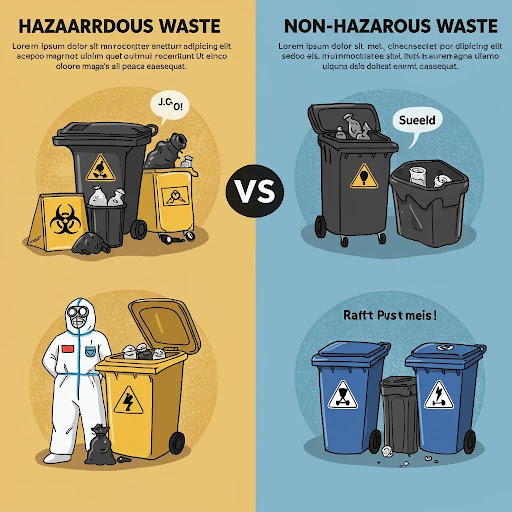
Hazardous waste services manage materials defined by regulation as ignitable, corrosive, reactive, or toxic, and they require specialized packaging, labeling, manifests, and licensed transporters to maintain the chain of custody. Non-hazardous services handle typical commercial solid waste and recyclable materials where standard containers and municipal or commercial haulers suffice, and documentation is lighter but still important for diversion tracking. Hazardous streams often trigger RCRA generator obligations, higher disposal fees, and stricter record retention; non-hazardous streams focus on cost-effective collection frequency and contamination reduction for recycling. For businesses, correctly classifying waste reduces liability and avoids costly violations, and early classification helps determine whether treatment, stabilization, or landfill disposal is needed. Understanding these regulatory and operational differences leads directly to evaluating provider capabilities and certifications that verify compliant handling.
How Do Recycling and Sustainable Waste Management Services Benefit Your Business?
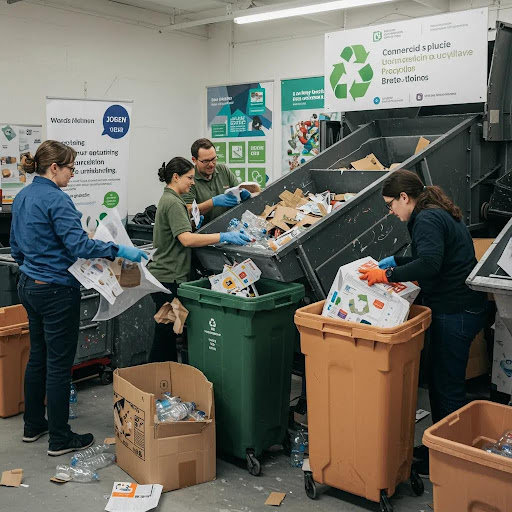
Recycling and sustainable waste services reduce disposal costs and create measurable diversion metrics that support corporate responsibility and regulatory reporting, while often unlocking material resale or reuse value for certain streams. Effective commercial recycling programs reduce per-ton disposal fees by redirecting paper, cardboard, metals, organics, and some plastics to processing, and they improve brand value for customers and investors by demonstrating circular economy commitments. These programs require contamination controls, employee training, and routine measurement to sustain diversion rates; technology and audits typically reveal quick wins like container right-sizing or targeted employee education. Quantifiable benefits commonly include lower waste hauling frequency, reduced landfill fees, and documented diversion percentages that feed sustainability reports. After examining these benefits, businesses should map program scope to expected outcomes and available provider services.
What Specialized Services Exist for Industrial and Commercial Waste Disposal?
Specialized services address complex streams such as sludges, lab packs, contaminated soils, industrial liquids, and regulated electronic waste that demand on-site treatment, thermal processes, or certified recycling pathways. Providers offering industrial services should have facility permits, specialized equipment (e.g., vacuum trucks, containment systems, thermal oxidizers), and documented procedures for characterizing and treating these streams safely. Typical triggers for specialized services include process upsets, construction remediation, lab closures, and large-scale equipment decommissioning, where technical expertise and permits are essential to minimize downtime. Safety considerations include worker training, spill prevention, and emergency contingency planning to limit exposure and regulatory impact. Evaluating provider capabilities for these specialized offerings naturally moves the conversation toward assessing regulatory knowledge, facility audits, and service customization.
How Can Emergency Response and Waste Treatment Services Protect Your Business?
Emergency response and waste treatment services deliver rapid containment, remediation, and regulatory reporting after spills, accidental releases, or other urgent waste events, which protects employees, assets, and compliance status. Rapid response providers maintain trained crews, certified equipment, and predefined protocols to stabilize incidents, perform on-site treatment where possible, and coordinate with regulators to manage manifests and corrective actions. Response time expectations, certifications, and insurance coverage are key credentials to verify before relying on an on-call arrangement, and contracts often include pre-planned escalation paths and notification procedures. Having an emergency plan and an established provider relationship reduces downtime, limits fines, and helps restore normal operations faster. Knowing how emergency capabilities integrate with ongoing treatment services leads to the provider evaluation framework covered next.
Different environmental waste providers can supply collection, treatment, recycling, and emergency response services; when assessing options, confirm which waste management services providers offer the exact mix of services you need and whether they provide waste audits, technology-enabled tracking, and documented regulatory support.
| Service Category | Typical Regulatory/Operational Attribute | Typical Business Impact |
|---|---|---|
| Hazardous Waste Disposal | Requires manifests, licensed transport, and regulated containers | Higher disposal cost, strict recordkeeping, compliance risk if mishandled |
| Non-Hazardous Collection | Standard containers, municipal or commercial haulers | Lower cost, focus on collection frequency, and contamination control |
| Commercial Recycling | Sorting, contamination management, and processor contracts | Diversion metrics, reduced landfill fees, and CSR benefits |
| Industrial Treatment & Remediation | Permitted facilities, specialized equipment, and on-site treatment | Enables complex waste handling, reduces downtime, permits required |
What Key Factors Should You Evaluate When Selecting an Environmental Waste Service Provider?
Selecting a provider demands a structured evaluation of experience, certifications, service range, compliance expertise, pricing transparency, and customer support so you can compare proposals on an apples-to-apples basis. Core criteria include verifying licenses and certifications that match your waste streams, reviewing safety and environmental records, confirming insurance and transporter credentials, and assessing the provider’s technology and reporting capabilities for traceability. Transparent pricing models with clear disposal pass-throughs and documented SLAs prevent unexpected fees, while responsive account management, training, and scheduled reviews indicate a partnership-oriented provider. Use the checklist in the following subsection to verify credentials and request a waste audit to benchmark scope and cost before executing any contract. Understanding these evaluation factors sets up an informed comparison between competing proposals and protects your business from regulatory or financial surprises.
How Important Are Experience, Reputation, and Certifications in Choosing a Provider?
Experience and certifications indicate a provider’s ability to manage complex streams and navigate regulatory processes; prioritize providers with documented permits, RCRA familiarity, transporter licensing, and third-party audits or safety certifications. Ask for references and case examples relevant to your industry, and request evidence of environmental compliance history—including incident logs and corrective actions—to verify claims. Interpreting experience involves assessing both years in business and demonstrated outcomes on similar waste profiles, since niche expertise (e.g., PFAS treatment or complex e-waste processing) can be more valuable than broad experience. Site visits to treatment facilities and review of staff training records provide practical confirmation of capability. These verification activities naturally lead to evaluating the service range and whether customization options meet your operational needs.
| Provider Attribute | Verification Step | Benchmark/Value |
|---|---|---|
| Licenses & Permits | Request copies of permits, transporter licenses | Match permits to waste types handled |
| Certifications | Ask for safety and environmental certifications | Third-party audits or ISO-type credentials preferred |
| References & Case Studies | Contact references, review similar projects | Successful compliance outcomes and measurable diversion |
What Service Range and Customization Options Should You Expect?
Providers commonly offer packaged services (scheduled pickups, standard recycling streams) and bespoke solutions (onsite consolidation, specialized treatment, zero-waste program design) that scale with your operations. Evaluate whether a provider can adjust pickup frequency, container types, and reporting cadence, and whether they support on-site training or contamination-reduction programs to improve recycling outcomes. Consider the provider’s ability to integrate technology such as load tracking or digital manifests, which aids transparency and cost allocation across business units. Scalability is essential: verify that the provider can expand services during growth or seasonal variance without compromising compliance. Assessing these customization options helps you balance cost efficiency with service flexibility.
- Packaged Services: Standardized collections and recycling streams suitable for predictable waste volumes.
- Customized Programs: Tailored schedules, on-site treatment, and specialized disposal for unique streams.
- Scalable Solutions: Ability to scale pickups and services during peak operations without service loss.
How Do Compliance and Regulatory Expertise Impact Your Waste Management Choice?
Providers with deep regulatory expertise reduce generator liability by managing manifests, waste profiling, and communication with regulators, and by maintaining accurate documentation for inspections and audits. Knowledge of RCRA obligations, state-level variations, and local permit requirements ensures proper classification and disposal pathways, lowering the risk of violations and fines. Providers should supply documentation such as waste profiles, manifests, disposal certificates, and training records; confirm retention periods and audit support services. When providers proactively flag regulatory changes or assist with permitting, they become partners in compliance rather than vendors. This compliance focus directly influences pricing transparency and contract terms in the next subsection.
What Role Does Cost and Pricing Transparency Play in Provider Selection?
Price structures vary—per pickup, per ton, flat-fee, or pass-through disposal—so standardizing quotes is essential to compare costs accurately by scope, frequency, and disposal destinations; identify typical hidden fees like fuel surcharges, long-haul transport, or special handling surcharges. Ask providers for sample invoices and a full breakdown of disposal, treatment, and administrative fees to avoid surprises, and include escalation clauses or caps in contracts when possible. Negotiation should focus on service levels, defined disposal rates, and periodic review points to adjust for volume changes; request sample SLAs that include response time and reporting cadence. Transparent pricing aligned with clear SLAs protects budgets and operational continuity. Waste minimization opportunities
Here is a short checklist you can use during provider verification to ensure thorough evaluation and to request a waste audit :
- Verify licenses, transporter credentials, and insurance documentation.
- Request recent client references and performance examples for similar waste streams.
- Ask for a sample SLA and invoice breakdown to identify hidden fees.
- Request a formal waste audit to establish baseline volume, composition, and optimization opportunities.
How Can Customer Service and Support Influence Your Long-Term Partnership?
Customer service and dedicated account management signal a provider’s commitment to operational reliability, training, and continuous improvement, with metrics such as response time and reporting cadence embedded in SLAs. Evaluate whether the provider offers scheduled reviews, training for staff on contamination reduction, timely incident escalation procedures, and accessible reporting dashboards for sustainability metrics. Strong account support reduces administrative burden and speeds problem resolution, which preserves production uptime and mitigates regulatory exposure. Request sample reporting templates and SLA response-time clauses to ensure expectations align. Ongoing support and regular reviews naturally bridge to compliance processes and performance monitoring post-selection.
| Service Feature | What to Verify | Business Benefit |
|---|---|---|
| Account Management | Frequency of reviews, named contacts | Improved responsiveness and program refinement |
| Reporting & Dashboards | Sample reports, KPI definitions | Transparency for compliance and sustainability claims |
| Training & Support | On-site training availability | Reduced contamination, improved diversion rates |
How Can Your Business Ensure Compliance with Environmental Waste Regulations?
Ensuring compliance requires a roadmap that maps federal frameworks like RCRA to state and local variations, clarifies generator responsibilities, and assigns documentation and recordkeeping tasks to responsible parties. Businesses must implement systematic waste characterization, ensure proper labeling and manifesting, retain records according to regulatory timelines, and verify that transporters and disposers hold appropriate licenses and insurance. A practical compliance strategy includes routine internal audits, scheduled reviews with the provider, training for staff handling waste, and a clear escalation process for incidents. Applying these practices minimizes regulatory risk, demonstrates due diligence during inspections, and supports accurate sustainability reporting. The following subsections summarize the relevant regulations, transporter roles, required documentation, and strategies for navigating local nuances.
What Federal and State Regulations Affect Hazardous and Commercial Waste Disposal?
The Resource Conservation and Recovery Act (RCRA) establishes federal hazardous waste generator obligations, manifesting, and cradle-to-grave tracking, while states apply their own rules that may be more stringent or include additional permitting requirements. Generators must classify wastes, follow accumulation time limits, use proper containers and labeling, and maintain manifests and waste profiles; state agencies often require additional notifications or permitting for certain waste types. Because state and local requirements vary, businesses should consult state environmental agencies and incorporate state-specific obligations into contracts and operational practices. Recent studies and agency guidance through 2025 emphasize adequate manifesting and electronic reporting as best practices for audit readiness. Understanding these frameworks informs provider capabilities that are essential for compliance support.
How Do Licensed Waste Transporters and Service Providers Help Maintain Compliance?
Licensed waste transporters and service providers manage the chain of custody, ensure proper packaging and labeling, complete manifests correctly, and often provide electronic tracking and final disposal certificates that limit generator liability. Verify transporter licensing, insurance coverage, and personnel training records to ensure they match the waste types and routes involved, and request copies of transporter credentials during due diligence. Providers that handle manifests and electronic reporting can reduce administrative burden and lower the risk of documentation errors that trigger enforcement actions. Providers should also maintain contamination prevention procedures and controlled receipt practices at disposal facilities to ensure regulatory acceptance. Properly selected transporters turn compliance obligations into manageable operational tasks.
What Documentation and Reporting Are Required for Regulatory Adherence?
Common documentation includes waste manifests, shipping papers, waste profiles, disposal or destruction certificates, and retention logs; retention periods vary by regulation but typically span several years for hazardous waste records. Accurate manifests with clear generator and transporter identification, quantity, EPA waste codes, and destination signatures form the core regulatory record; disposal certificates and treatment documentation complete the chain of custody. Providers should deliver consolidated reporting and periodic summaries that align with audit timelines and internal retention policies, and businesses should store records in searchable formats to speed audits. Structuring documentation workflows around these requirements improves audit readiness and regulatory confidence.
| Regulatory Framework | Required Documentation | Responsible Party |
|---|---|---|
| RCRA (Federal) | Manifests, waste profiles, treatment/disposal certificates | Generator / Transporter / Disposer |
| State Regulations | State-specific permits, notifications, and electronic reports | Generator / Provider (as specified) |
| Facility Records | Training logs, incident reports, and inspection records | Service Provider / Generator |
How Can You Navigate Local Regulatory Nuances Effectively?
Navigating local nuances starts with identifying applicable city and county ordinances, consulting state agency guidance, and asking providers how they handle local permitting and disposal restrictions in your operational area. When local rules are ambiguous, seek provider regulatory experts or legal counsel to interpret permit triggers and apply for necessary approvals; providers with multi-state experience often maintain templates and precedents that accelerate permitting. Keep a curated dossier of local requirements and update it annually or when operations change, and ask providers for examples of handling local permit challenges. This proactive approach prevents shutdowns and positions your business to adapt to regulatory changes quickly. For more information, visit navigating waste laws.
How Do Advanced Technologies Improve Environmental Waste Management Services?
Advanced technologies—waste audits using data analytics, IoT sensors for fill-level monitoring, AI-assisted sorting, and digital manifesting—improve efficiency, reduce cost, and strengthen compliance through better data and operational optimization. Waste auditing tools provide baseline measurement and identify diversion opportunities while IoT sensors optimize routing and reduce unnecessary pickups, lowering fuel use and emissions. AI sorting improves material recovery at processors by reducing contamination and increasing the yield of recyclable materials, while digital tracking and dashboards supply the documentation auditors require. These technologies also enable measurable KPIs, allowing businesses to quantify diversion rates, cost per ton, and emissions avoided. The subsections below detail audit benefits, IoT/AI implementations, sustainability reporting, and emergency response tech.
What Are the Benefits of Waste Auditing and Optimization Technologies?
Waste audits collect baseline composition and volume data that reveal quick wins—container right-sizing, pickup frequency changes, and diversion opportunities—that typically yield immediate cost reductions and higher diversion rates. Audits follow defined steps: inventory streams, measure weights/volumes over a sample period, analyze composition, and recommend operational changes. Common audit findings include over-servicing routes or high contamination in recycling streams. Optimization actions derived from audits produce measurable outcomes such as reduced pickups, lower disposal costs, and improved recycling capture rates. Audits also create the data foundation needed for technology deployment and long-term sustainability metrics.
- Inventory: Track types and volumes across a representative period.
- Analysis: Identify contamination, frequency inefficiencies, and right-sizing opportunities.
- Implementation: Apply recommendations and monitor KPIs to measure ROI.
These steps connect audit insights to practical changes that reduce cost and environmental impact.
How Do IoT, AI, and Digital Tracking Enhance Waste Stream Management?
IoT sensors on containers measure fill levels to enable route optimization, reducing pickups and fuel consumption while maintaining service reliability; these sensors integrate with routing platforms to dynamically schedule collections. AI improves sorting accuracy at processing facilities by identifying contaminants and directing materials to correct streams, which increases recovery rates and lowers processor rejection fees. Digital manifesting and blockchain-style records enhance traceability and reduce paperwork errors, streamlining compliance workflows and enabling near-real-time reporting. Together, these technologies create transparent, auditable data flows that demonstrate compliance and support continuous improvement.
How Can Technology Support Sustainability and Reporting Initiatives?
Technology aggregates diversion metrics, tonnages recycled, and emissions avoided to create repeatable sustainability reports that stakeholders and regulators can trust, and it supports circular economy initiatives by tracking material flows back to reuse or remanufacturing partners. Typical KPIs include diversion rate, tons recycled, cost per ton, and emissions avoided; reporting frequency ranges from monthly operational dashboards to annual sustainability reports. Digital dashboards simplify stakeholder communication by providing visual metrics and trend analysis, helping businesses demonstrate progress toward circularity goals. Effective reporting systems also streamline external audits and certification processes.
What Emergency Response Technologies Improve Safety and Efficiency?
Emergency response technologies like remote monitoring, plume modeling, and rapid communications platforms speed detection and decision-making during incidents, reducing exposure and environmental impact. Remote sensors detect anomalies, automated alerts mobilize response teams, and modeling tools predict contaminant spread for informed containment strategies; these technologies shorten the response window and minimize required remediation. Integration of emergency tech with provider response plans ensures coordinated action and documented remediation steps. The use of technology in emergency response complements prevention efforts and supports regulatory reporting after incidents.
How Should Your Business Assess Its Waste Needs Before Choosing a Service Provider?
Assessing waste needs requires a structured inventory of waste types, measured volumes, generation frequency, and identification of industry-specific regulatory drivers so providers can propose accurate scopes and pricing. Start with a simple inventory process over a representative period, capture container types and weights, and categorize streams by regulatory status to determine required handling and documentation. Industry-specific constraints—such as healthcare-regulated medical waste, manufacturing process residues, or construction demolition debris—drive provider selection toward niche capabilities. Performing a waste audit provides quantified baselines that inform RFP scopes and help compare provider proposals on equivalent terms. The next subsections provide practical measurement methods, industry considerations, and audit benefits.
What Types and Volumes of Waste Does Your Business Generate?
Inventory waste streams by location and process, measure volumes using scale tickets or weigh estimates over a defined period, and record pickup frequency to model annual tonnage and cost implications. Use simple tracking templates to log container types, fill levels, and approximate weights for distinct streams; collect data over a representative one- to four-week period to capture operational variability. This data enables precise RFP requests and reduces assumptions in provider proposals, ensuring apples-to-apples comparisons. Accurate measurement also supports container right-sizing and scheduling changes that lower costs and emissions.
How Do Industry-Specific Waste Requirements Affect Service Selection?
Different industries face distinct regulated streams: healthcare requires regulated medical waste handling, manufacturing may produce hazardous process wastes or sludges, hospitality handles organics and food waste, and construction generates bulky debris and contaminated soils. Providers with vertical experience understand permit triggers, typical waste profiles, and specialized handling protocols for each sector, which reduces onboarding time and prevents compliance gaps. When selecting providers, prioritize those with documented success and relevant capabilities for your industry to ensure operational fit. Industry-specific requirements naturally influence the scope of RFPs and the types of evidence you request during due diligence.
How Can Waste Audits Help Identify Optimization Opportunities?
Waste audits deliver a prioritized roadmap of optimization actions—container right-sizing, recycling stream expansion, pickup consolidation, or employee training—that yield both cost and diversion improvements. Audits typically include measurement, composition analysis, identification of contamination sources, and a recommended action plan with estimated savings and diversion impacts. Prioritize quick wins that require minimal capital but produce immediate cost reductions, then sequence longer-term projects such as technology deployment or process changes. Audits also inform contractual terms and SLA metrics when you request proposals.
| Audit Phase | Key Task | Expected Outcome |
|---|---|---|
| Baseline Measurement | Capture volumes and composition | Quantified tonnage and contamination rates |
| Analysis | Identify inefficiencies | Priority actions and estimated savings |
| Implementation Planning | Design container and schedule changes | Cost reduction and diversion improvement |
What Is the Best Process for Selecting and Partnering with an Environmental Waste Service Provider?
The best selection process is a step-by-step workflow: prepare a detailed RFP informed by your waste audit, standardize comparison metrics, perform due diligence on shortlisted providers, negotiate contracts with clear SLAs and indemnities, and implement a monitoring cadence for continuous optimization. Standardizing proposal fields—scope, pricing breakdown, disposal destinations, insurance, and references—creates apples-to-apples comparisons and simplifies decision-making. Perform reference checks, verify permits and insurance, conduct site visits, and request sample SLAs during due diligence to mitigate risk. Post-selection, define KPIs, schedule regular reviews, and maintain open communication for continuous improvement. The following subsections expand on requesting proposals, due diligence steps, contract terms, and ongoing monitoring.
How Do You Request and Compare Waste Management Proposals Effectively?
An effective RFP includes your waste audit data, clearly defined streams, expected pickup frequencies, container types, reporting requirements, and compliance obligations; it requires a full price breakdown including disposal and pass-through fees. Use a comparison matrix with standardized fields—unit rates, disposal destinations, transport distances, insurance limits, and SLAs—to evaluate bids objectively and identify hidden costs. Ask providers to include examples of similar projects and sample reports to validate reporting capabilities. This structured approach simplifies negotiation and clarifies which provider delivers the best combination of cost, compliance, and service flexibility.
- Include Audit Data: Provide measured volumes and compositions for accurate proposals.
- Request Detailed Pricing: Ask for unit rates, disposal fees, and any surcharges.
- Standardize Responses: Use a comparison matrix to score proposals consistently.
What Due Diligence Steps Should You Take Before Finalizing a Provider?
Conduct reference checks that emphasize similar waste streams and regulatory outcomes, verify permits and transporter licenses, confirm insurance and financial stability, and perform facility site visits when specialized treatment or long-term disposal is involved. Look for red flags such as incomplete documentation, unwillingness to share incident history, or vague SLA terms. Confirm staff training programs and safety practices to evaluate operational rigor; request copies of recent audit reports if available. Thorough due diligence protects your business from onboarding a provider that cannot meet compliance or service expectations.
How Do Contract Negotiations and Service Level Agreements Protect Your Business?
Contracts should include defined SLAs for pickup frequency, response times for incidents, reporting cadence, performance KPIs (diversion %, cost per ton), insurance and indemnity clauses, and termination or penalty terms tied to service failures. Negotiate clear definitions around responsibility for manifests, sampling, and corrective actions in the event of non-compliance; include audit rights and periodic review clauses to adjust scope as operations change. Specify acceptable escalation procedures and acceptable response windows for emergency response services. Well-constructed contracts convert expectations into enforceable obligations that limit exposure and support operational continuity. See our contract insights.
How Can You Monitor Performance and Optimize Waste Management Post-Selection?
Establish a monitoring cadence—monthly operational reviews and quarterly strategic meetings—using KPIs such as diversion rate, cost per ton, pickups per month, and compliance incidents to evaluate performance and identify optimization opportunities. Maintain scheduled audits and review reported data against actual measured tonnages to detect discrepancies, and request corrective action plans when KPIs fall short. Use performance data to renegotiate scope, adjust containers, or re-bid services if necessary; continuous improvement cycles preserve cost savings and increase diversion. This monitoring mindset ensures the relationship remains value-driven and compliant. For more information on waste management, visit diversion.
As you move from selection to partnership, request proposals and schedule a formal waste audit with qualified providers to validate assumptions and measure achievable cost and diversion improvements. Sustainable waste solutions.
How Can Sustainable Waste Management Services Enhance Your Business’s Environmental Impact?
Sustainable waste management services apply waste reduction, diversion, circular-economy principles, and robust reporting to reduce environmental footprint while unlocking business value through lower disposal costs and enhanced stakeholder trust. Strategies include source reduction, reuse and remanufacturing partnerships, targeted recycling and composting, and supplier or packaging changes to enable circular loops. Measuring impact through consistent KPIs—diversion rate, tons recycled, emissions avoided, and cost savings—supports credible sustainability claims and investor reporting. The final subsections unpack effective reduction strategies, circular economy applications, and impact reporting practices.
What Are Effective Waste Reduction and Diversion Strategies?
Effective strategies follow the waste hierarchy: source reduction, reuse, recycling, and recovery, combined with operational measures such as container right-sizing, staff training, and prioritized recycling streams to minimize landfill disposal. Design programs with contamination controls, clear signage, and routine performance monitoring to sustain diversion rates; pilot projects like organics collection or expanded metal recycling often produce measurable gains. Quick wins include consolidating pickups, introducing segregated streams for high-value materials, and supplier engagement to reduce packaging. Tracking diversion metrics monthly helps prioritize actions that deliver the greatest environmental and financial return.
How Do Circular Economy Principles Apply to Business Waste Management?
Circular economy approaches focus on keeping materials in use through reuse, remanufacturing, and material recovery partnerships that transform waste into feedstock for other processes. Businesses can partner with processors and remanufacturers to return materials into supply chains, adjust procurement standards to prefer returnable packaging, and implement take-back programs that divert usable materials from disposal. Procurement and packaging changes often unlock circular pathways and create new revenue or cost-avoidance opportunities. Applying circular principles requires coordination across procurement, operations, and waste partners to capture value and close material loops.
How Can Environmental Impact Reporting Demonstrate Your Business’s Commitment?
Impact reports should include core KPIs—diversion rate, tons recycled, emissions avoided, and cost savings—clearly defined methodologies for measurement, and a narrative linking waste initiatives to broader corporate sustainability goals. Use technology-enabled dashboards to generate consistent monthly and annual reports, and include documented evidence such as disposal certificates and third-party verification where applicable. Distribute reports to stakeholders via annual sustainability disclosures or internal dashboards to ensure transparency and accountability. Regular reporting demonstrates continuous improvement and supports regulatory and customer expectations.
For an actionable next step, request a waste audit or compare licensed providers using standardized RFP templates and the checklists above to quantify potential cost savings, diversion improvements, and compliance risk reduction.
About the author