Introduction
Building site waste management is one of the most critical — and most overlooked — aspects of modern construction. Every year, the construction and demolition sector generates hundreds of millions of tonnes of waste globally, making it one of the largest contributors to landfill waste. For contractors, project managers, and developers, poor waste management doesn’t just damage the environment; it inflates project costs, exposes companies to regulatory penalties, and harms a business’s reputation.
Whether you’re managing a small residential renovation or a large commercial development, having a robust waste management plan in place from day one is no longer optional — it’s a professional and legal necessity. This guide covers everything you need to know about building site waste management: what it involves, why it matters, the types of waste you’ll encounter, legal obligations, best practices, and how to build a waste management plan that works.
What Is Building Site Waste Management?
Building site waste management is the systematic process of identifying, segregating, storing, transporting, recycling, and disposing of waste generated during construction, renovation, or demolition. It encompasses everything from surplus bricks and timber offcuts to hazardous materials such as asbestos, lead-based paint, and contaminated soil.
Effective waste management on a building site goes beyond simply hiring a skip. It involves planning ahead, tracking waste streams, maximizing material recovery, working with licensed waste carriers, and maintaining accurate records for compliance purposes.
Why Building Site Waste Management Matters
Cost Reduction
Waste costs money — twice. First, you pay for the materials you ordered but didn’t use. Second, you pay to have those unused materials removed and disposed of. Studies consistently show that better waste planning can reduce material waste by 10–15%, delivering direct savings to the project budget.
Legal Compliance
In most countries, construction businesses have a legal duty of care for the waste they produce. In the UK, for example, the Environmental Protection Act 1990 and the Waste (England and Wales) Regulations 2011 place strict obligations on producers of construction waste. Failing to comply can result in significant fines, enforcement notices, and even prosecution.
Environmental Responsibility
Construction waste that ends up in landfills contributes to greenhouse gas emissions, soil contamination, and loss of valuable land. Diverting waste from landfill through recycling and reuse is one of the most impactful steps the construction industry can take toward genuine sustainability.
Reputation and Procurement
Clients, local authorities, and planning bodies increasingly ask contractors to demonstrate their environmental credentials. A site that manages waste poorly risks losing bids, failing planning conditions, and attracting negative press coverage.
Types of Waste Generated on Building Sites
Understanding your waste streams is the first step toward managing them effectively. The main categories include:
Inert waste — concrete, bricks, tiles, ceramics, sand, and gravel. These materials do not decompose or react chemically, making them relatively straightforward to recycle or crush for reuse as aggregates.
Non-hazardous waste — timber, plasterboard, insulation, packaging, metals, and mixed construction debris. While not chemically dangerous, this category accounts for the bulk of construction waste by volume and requires careful segregation to enable recycling.
Hazardous waste — asbestos, lead-based paint, solvent-contaminated materials, and certain adhesives or sealants. Hazardous waste requires specialist handling, licensed contractors, and specific disposal routes. Mismanagement carries the heaviest legal and health consequences.
Liquid waste — cement washings, paint residues, and fuel spillages. These must be prevented from entering drains or watercourses, as they can cause serious environmental damage.
Excavation materials — topsoil, subsoil, and rock removed during groundworks. Much of this can be reused on-site or sold as secondary aggregate, dramatically reducing disposal costs.
Legal Obligations for Construction Waste
Duty of Care
Every business that produces, imports, carries, keeps, treats, or disposes of waste has a legal duty of care to ensure that waste is handled safely and responsibly throughout the waste chain. This means:
- Only using licensed or registered waste carriers
- Accurately describing the waste on transfer notes
- Ensuring waste is taken to an authorised facility
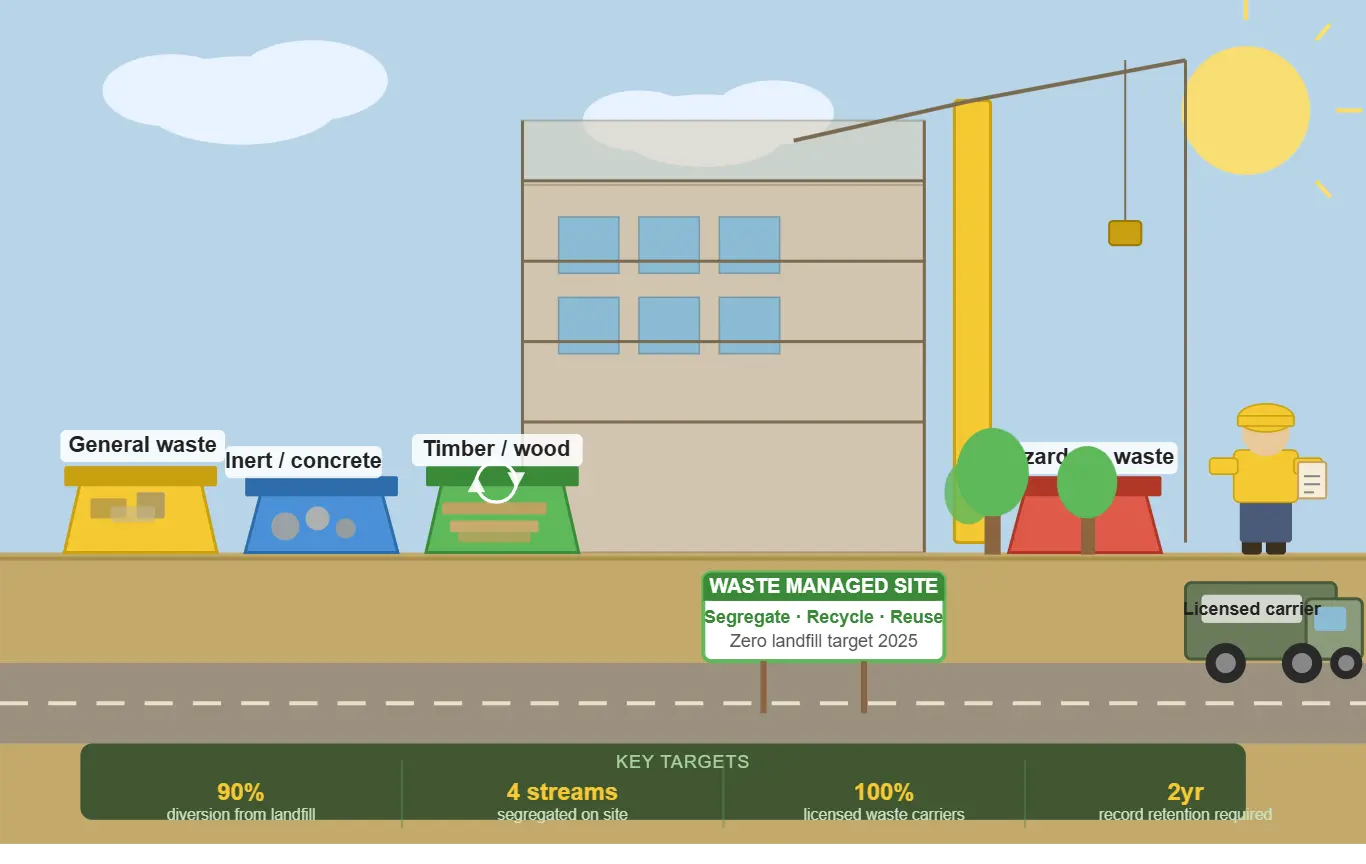
- Keeping waste transfer notes for a minimum of two years
Waste Transfer Notes
Whenever construction waste is handed over to a waste carrier, a waste transfer note must be completed. This document records what the waste is, where it came from, and who is taking responsibility for it. Digital waste transfer notes are increasingly accepted and make record-keeping simpler.
Site Waste Management Plans (SWMPs)
While site waste management plans are no longer legally mandatory in England, they remain a best-practice standard and are required by many local authorities as a planning condition. A well-prepared SWMP identifies expected waste types and quantities, sets targets for diversion from landfill, and assigns responsibility for waste handling to named individuals on the site.
Hazardous Waste Consignment Notes
Hazardous waste requires separate consignment notes and must be disposed of by licensed hazardous waste contractors. Never mix hazardous waste with general construction waste.
Best Practices for Building Site Waste Management
1. Plan Before You Build
The most effective time to reduce waste is before a single brick is laid. During design and procurement, review specifications to minimise over-ordering, standardise material sizes to reduce off-cuts, and consider off-site prefabrication which can reduce on-site waste by up to 90% for certain components.
2. Segregate Waste at Source
Mixing different waste streams together is the single biggest mistake on construction sites. When timber, plasterboard, metals, and plastics are all thrown into the same skip, recyclable materials become contaminated and largely worthless. Dedicated bins or skips for each major waste type allow higher recycling rates and can significantly reduce disposal costs.
3. Designate a Waste Champion
Appoint a named individual on site — often a site manager or environmental officer — who is responsible for enforcing the waste management plan, ensuring segregation is maintained, and completing the necessary paperwork. Without clear ownership, waste plans are quickly abandoned under project pressure.
4. Use Licensed Waste Carriers
Always check that the company removing your waste holds a valid waste carrier licence. In the UK, these can be verified through the Environment Agency’s public register. Using an unlicensed carrier not only breaks the law but leaves the waste producer liable if the waste is fly-tipped.
5. Track and Measure
You cannot manage what you do not measure. Keep records of the volumes and types of waste leaving the site, the recycling rate achieved, and the costs incurred. This data improves future project planning and provides evidence for clients who require sustainability reporting.
6. Reuse Materials On-Site
Before arranging for materials to be removed, consider whether they can be reused elsewhere on the project. Excavated topsoil can be redistributed for landscaping. Reclaimed timber can be used for temporary hoarding. Surplus bricks and blocks can sometimes be used as hardcore or donated to community projects.
7. Engage Your Supply Chain
Require suppliers to take back excess packaging and unused materials where possible. Many building material suppliers now offer take-back schemes for off-cuts and pallets. Make these obligations clear in procurement contracts.
Building a Site Waste Management Plan
A practical site waste management plan should include:
- Project details — site address, project type, expected duration, and the person responsible for waste management
- Waste forecast — estimated quantities and types of waste based on the scope of works
- Segregation strategy — which waste streams will be separated, and how
- Storage arrangements — location of skips, bins, and hazardous waste storage on the site plan
- Approved contractors — names and licence numbers of all waste carriers and disposal sites
- Targets — percentage of waste to be diverted from landfill
- Record-keeping — how waste transfer notes and tonnage data will be captured and stored
Review and update the plan throughout the project as scope changes and new waste streams emerge.
The Future of Building Site Waste Management
The construction industry is under growing pressure to move toward a circular economy model — one in which materials are kept in use for as long as possible and waste is designed out entirely. Innovations such as building information modelling (BIM) are making it easier to quantify and minimise material waste at the design stage. Digital waste tracking platforms are replacing paper-based systems, providing real-time data on waste volumes and recycling rates. Material exchanges and digital marketplaces are growing, making it easier to find buyers or recipients for surplus materials that would otherwise be skipped.
For construction businesses, investing in strong waste management practices today is not just about avoiding fines or hitting a recycling target. It is about building the systems, culture, and reputation that will win work and sustain the business in an increasingly sustainability-conscious market.
Conclusion
Building site waste management is a discipline that pays dividends at every level — financial, legal, environmental, and reputational. By planning waste reduction into the design stage, segregating waste streams on site, working only with licensed carriers, and measuring performance consistently, construction businesses can dramatically cut costs while meeting their legal obligations and demonstrating genuine environmental responsibility.
Start with a clear site waste management plan, assign ownership, and build waste management into the culture of every project from day one. The construction industry has a significant role to play in reducing global waste — and the businesses that lead on this issue will be better positioned for the future.
About the author