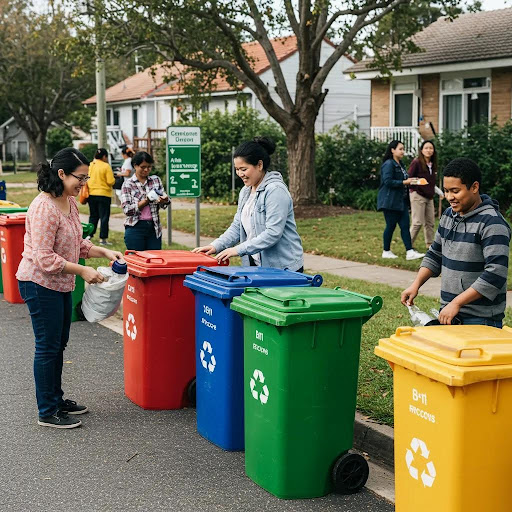
Local recycling programs are organized efforts by municipalities, businesses, haulers, and material recovery facilities to capture reusable materials and divert waste from landfills. They increasingly rely on commercial recycling solutions to scale impact across communities. This article explains how coordinated local programs operate, how commercial recycling amplifies diversion, and the operational tools—such as commercial dumpster rental—that make high-volume recycling feasible for businesses of all sizes. Many communities face growing waste streams, contamination challenges, and regulatory pressures; effective local programs combine collection design, business engagement, and measurable reporting to reduce landfill use and support circular economy goals. Readers will learn practical program models, step-by-step implementation guidance for multi-location organizations, industry-specific protocols, and cost-optimization tactics that create measurable community benefits. The guide also examines compliance and ESG reporting mechanics and highlights tools businesses can deploy to improve diversion rates and reduce costs while strengthening community recycling systems.
What Are Local Recycling Programs and Their Impact on Communities?
Local recycling programs are coordinated systems for collecting, sorting, and recovering materials from residential and commercial sources, designed to reduce landfill dependence and recover value from waste streams. These programs work by establishing collection standards, partnering with material recovery facilities (MRFs) and haulers, and engaging stakeholders through education and policy, which together increase recycling rates and lower environmental footprints. The result is measurable reductions in greenhouse gas emissions, conserved natural resources, and new local jobs in processing and reuse. Understanding these program mechanics clarifies why businesses are essential partners in achieving community diversion goals and why consistent commercial participation matters for program stability.
How Do Local Recycling Programs Support Sustainable Waste Management?
Local programs support sustainability through collection standardization, infrastructure partnerships, and public engagement that enable efficient material recovery and closed-loop resource flows. Collection systems—single-stream, dual-stream, and separate organics—are matched to local MRF capabilities to maximize recovery while minimizing contamination, and partnerships with composters and recyclers create end-markets for recovered materials. Public education campaigns and business outreach reduce contamination rates and boost participation, improving throughput and the economics of recycling. These operational practices set the stage for businesses to adopt compatible systems that scale community-wide diversion.
What Role Do Businesses Play in Local Recycling Initiatives?
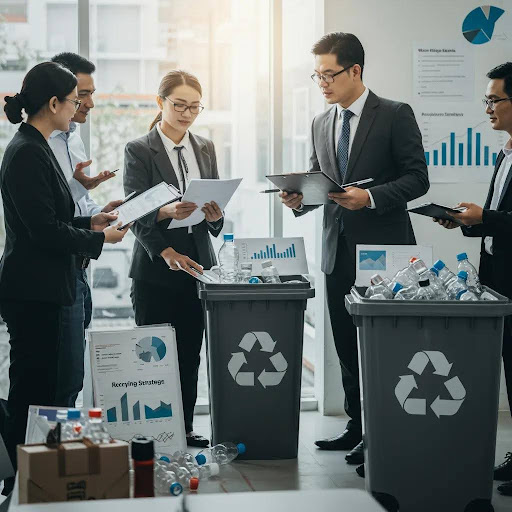
Businesses provide the bulk of commercial recyclables, leadership in procurement, and scalable collection infrastructure that amplify municipal efforts through high-volume diversion and standardized practices. By adopting segregation protocols, specifying recycled-content procurement, and coordinating containerization, companies reduce contamination and create steady material streams that support local markets. Multi-location businesses have an outsized influence: standardized programs across sites simplify municipal planning and improve aggregate diversion metrics. Business participation also signals market demand for circular products, encouraging manufacturers and processors to invest in recycling capacity and innovation.
How Are Local Recycling Programs Measured for Success?
Program success is measured with KPIs such as diversion rate, contamination rate, participation rate, and cost per ton, which together indicate environmental and economic performance. Diversion rate measures the percentage of waste diverted from landfill to recycling or composting, while contamination rate shows the share of non-acceptable materials undermining material quality; participation gauges user engagement and collection coverage. Reliable measurement requires periodic waste audits, weigh-scale data, and aggregated reporting from haulers and MRFs—methods that enable continuous improvement and accountability. Regularly tracking these metrics lets municipalities and businesses align strategies and demonstrate progress toward community goals.
Local recycling programs deliver community-wide environmental gains by organizing collection and measurement systems that businesses help power through consistent operational practices and data-driven collaboration.
How Do Commercial Recycling Programs Enhance Community Recycling Efforts?
Commercial recycling programs are structured approaches businesses use to capture recyclables—such as cardboard, mixed recyclables, organics, and e-waste—which increase overall community diversion by creating consistent, high-volume supply chains to processing facilities. These programs amplify municipal initiatives through standardized materials segregation, consolidated hauling, and precise reporting that feed municipal planning and market development. When businesses align collection models and reporting, communities see smoother MRF operations, reduced contamination, and stronger material markets. Clear operational protocols and vendor coordination are central to unlocking these benefits for neighborhoods and municipalities. For more information, read about how to implement a successful recycling program.
What Types of Commercial Recycling Programs Are Available for Businesses?
Commercial programs include single-stream and dual-stream recycling, organics/food waste collection, electronic waste programs, and specialized material recovery (like metal or cardboard compaction), each chosen based on material types and local processing capacity. Single-stream simplifies participation but can raise contamination; dual-stream preserves material quality but requires more sorting at source. Organics diversion often uses separate collection or on-site composting for food waste, with regulatory and market considerations guiding program choice. Choosing the right model depends on a business’s material profile, local MRF capabilities, and contamination tolerance.
The following list outlines common program types and their typical strengths:
- Single-stream recycling: easy participation and broad acceptance.
- Dual-stream recycling: higher material quality and better market value.
- Organics diversion: reduces landfill methane and produces compost.
- E-waste programs: safe handling of electronics and regulatory compliance.
These program models allow businesses to select practical approaches that match local infrastructure and community goals, improving overall recycling program performance and economic outcomes.
How Can Businesses Implement Effective Recycling Programs?
Effective implementation follows a roadmap of assessment, vendor selection, piloting, and scale-up with clear metrics and training to ensure consistent results across sites. Begin with a waste audit to quantify volumes and contamination risks, then consolidate vendor contracts and standardize container types to reduce complexity. Pilot one or several sites to refine collection schedules and signage, then roll out across locations with employee training and monitored KPIs. Ongoing audit and reporting keep programs responsive and aligned with municipal needs.
What Are the Benefits of Commercial Recycling for Local Communities?
Commercial recycling programs deliver economic, environmental, and social benefits by increasing diversion, creating processing jobs, and improving municipal recycling performance through steady material streams. Economically, recovered materials generate revenue and reduce landfill tipping fees; environmentally, diversion lowers emissions and preserves resources; socially, recycling programs create local employment and community engagement opportunities. By coordinating with businesses, municipalities can scale diversion targets more reliably and accelerate progress toward zero-waste goals.
Why Is Commercial Dumpster Rental Essential for Business Waste Recycling Solutions?
Yes — commercial dumpster rental is essential because it provides the capacity, segregation, and operational simplicity businesses need to collect and manage recyclables at scale, supporting consistent diversion and compliance. Rentals allow businesses to match container types and capacities to material streams, enable temporary or project-specific needs, and reduce capital expenditures associated with ownership. Proper containerization minimizes contamination by making separation intuitive and reliable, and rentals can be specified to meet site access and hauling constraints. These operational benefits make dumpster rental a practical foundation of scalable commercial recycling programs.
What Dumpster Sizes and Types Are Best for Recycling Different Materials?
To help match containers to common material streams, the following table maps dumpster types to capacity, typical use, and material types so readers can quickly choose appropriate rentals for their sites
| Dumpster Type | Capacity / Typical Use | Material Types |
|---|---|---|
| Front-load 2–4 yd | Compact, frequent collections for small sites | Mixed recyclables, front-of-house paper |
| Roll-off 20–30 yd | Project large-volume capture for construction or events | Cardboard, bulk mixed recyclables |
| Compactor (stationary) | High-volume, continuous collection for back-of-house operations | Cardboard, mixed paper, plastics |
| Organics bin (front- or roll-off) | Compostable streams from food-generating sites | Food waste, yard waste |
Summary paragraph: Matching dumpster type to material stream reduces contamination and hauling costs while improving diversion; using the right capacity simplifies routing and collection frequency decisions. strategic waste diversion business cost savings
How Do Temporary and Permanent Dumpster Rentals Differ for Recycling Needs?
Temporary roll-off rentals serve short-term needs like construction, events, or seasonal surges and provide flexible capacity with on-demand pickup, while permanent front-load dumpsters or compactors support ongoing programs with scheduled collections and stable placement. Temporary solutions reduce short-term landfill diversion gaps and handle peak volumes without long-term commitment; permanent rentals optimize labor flows, signage, and routine auditing for continuous diversion. Cost considerations include rental duration, pickup frequency, and space requirements—temporary rentals avoid capital expenditure but may have higher per-day rates, whereas permanent rentals lower operational friction through consistent logistics. Selecting temporary versus permanent rental models depends on program duration, volume predictability, and site-specific constraints. Business cost savings.
How Does Dumpster Rental Simplify Multi-Location Business Recycling?
Centralized dumpster rental management standardizes container types, collection schedules, and vendor oversight across many locations, reducing procurement complexity and enabling consolidated reporting for diversion performance. Central contracts with coordinated specifications streamline invoicing and ensure consistent service levels, while standardized containers make employee training and signage uniform across sites. Centralized data collection supports network-level waste audits and helps identify optimization opportunities such as route consolidation or compaction deployment. These operational efficiencies allow multi-location businesses to scale recycling programs while maintaining control over cost and compliance.
To support businesses ready to operationalize these benefits, National Waste Associates offers commercial dumpster rental solutions tailored for multi-location organizations, with consolidated vendor management, continuous invoice auditing, and options for temporary and permanent rentals to meet varied recycling needs. National Waste Associates leverages an extensive hauler network and centralized reporting to help businesses implement scalable, compliant recycling programs that support local diversion goals.
How Can Businesses Optimize Their Recycling Programs for Greater Community Impact?
Optimization combines precise waste stream analysis, employee training, and adoption of zero-waste initiatives to increase diversion, reduce contamination, and strengthen community outcomes. Analytics from audits inform container sizing and routing, training reduces contamination and improves participation, and zero-waste frameworks shift procurement and operations toward reuse and source reduction. The interplay of these tactics delivers measurable gains for both businesses and communities, creating sustained improvements in material quality and diversion rates.
What Is Waste Stream Analysis and How Does It Improve Recycling Efficiency?
Waste stream analysis starts with a waste audit—sorting and weighing sample loads—to identify volumes, contamination, and high-impact streams; the resulting data drives container planning, routing, and vendor selection. Conduct audits periodically and after operational changes to validate assumptions and tune collection frequencies and container capacities. Translating audit results into action typically yields reductions in contamination and fewer missed pickups, improving MRF acceptance rates and material value. This data-driven process feeds continuous improvement and enables targeted investments where they yield the greatest diversion impact.
Intro paragraph to EAV table: The following table summarizes common waste streams and recommended containers to make audit findings actionable.
| Waste Stream | Contamination Risk / Typical Volume | Recommended Container |
|---|---|---|
| Cardboard | Low risk, high volume in retail | Roll-off or compactor |
| Mixed recyclables | Moderate risk, medium volume | Front-load 2–4 yd with clear signage |
| Organics | High contamination if mixed, variable volume | Dedicated organics bin or roll-off |
| E-waste | Low frequency, high regulatory control | Secure collection box, scheduled pickups |
Summary paragraph: Mapping streams to container recommendations allows businesses to convert audit insights into specific equipment and schedule choices that enhance diversion and reduce processing costs.
How Can Employee Training Enhance Recycling Compliance and Participation?
Effective training combines clear signage, regular briefings, and easy-to-follow protocols to reduce contamination and maintain participation across shifts and sites. Training should include material examples, contamination consequences, and simple sorting rules reinforced by visual aids and periodic refreshers; supervisors should monitor performance and recognize compliance successes. Measurement—through contamination checks and participation tracking—validates training efficacy and identifies areas needing reinforcement. Consistent training across locations ensures employees understand both environmental goals and operational requirements, which improves recycling outcomes and community benefits.
What Are Zero Waste Initiatives and How Do They Transform Business Recycling?
Zero waste initiatives prioritize source reduction, reuse, composting, and circular procurement to minimize residual waste sent to landfill, fundamentally shifting business operations toward material efficiency and long-term savings. Implementing zero waste involves redesigning packaging, establishing reuse systems, and working with suppliers to close material loops, alongside robust metrics to track progress. These programs require cross-functional coordination—procurement, operations, facilities—and often deliver reduced hauling costs, stronger ESG narratives, and greater resilience against material market shifts. For communities, widespread adoption of zero waste by businesses accelerates resource recovery and reduces municipal collection burdens.
A stepwise list summarizes optimization steps businesses can take:
- Conduct a waste audit and prioritize high-volume streams.
- Standardize containers and collection schedules based on audit data.
- Train staff and implement contamination monitoring programs.
- Adopt zero-waste purchasing and reuse strategies to lower residuals.
These steps create an actionable path to both lower costs and higher community diversion.
What Industry-Specific Recycling Solutions Support Local Recycling Programs?
Industry-specific recycling strategies tailor containerization, handling, and vendor partnerships to sectoral needs—manufacturing, retail, and healthcare each require distinct approaches to maximize diversion while maintaining safety and compliance. Understanding these differences helps municipalities and businesses align infrastructure investments and regulatory expectations to optimize local recovery.
How Do Manufacturing Facilities Manage Industrial Recycling Services?
Manufacturing facilities often deploy high-capacity compactors, balers, and roll-offs to handle heavy volumes of cardboard, plastics, and metal by-products, with upstream segregation to protect material value. Operational integration involves scheduling pickups aligned with production cycles, designating staging areas to minimize cross-contamination, and partnering with processors that accept specific industrial streams. Facilities may also pursue on-site processing for metals or pallets to capture additional value. These operational controls ensure manufacturing recycling supports both facility efficiency and community diversion goals.
What Are Effective Retail Waste and Recycling Programs?
Retail operations benefit from cardboard compaction, front-of-house recycling receptacles, and back-of-house consolidation to manage high volumes during peak periods while maintaining customer-facing cleanliness. Key practices include routine baling of cardboard, peak-season pickup adjustments, and clearly marked bins for customer recycling. Vendor scheduling should account for promotional surges and holiday spikes to avoid overflow and contamination. These measures help retailers reduce hauling costs, improve material recoverability, and contribute consistent tonnage to local recycling systems.
How Do Healthcare Businesses Ensure Recycling Compliance and Safety?
Healthcare recycling requires strict segregation between regulated medical waste and recyclable streams, clear protocols to prevent cross-contamination, and staff training on PPE and handling procedures to protect personnel and patients. Non-hazardous recyclables—paper, cardboard, certain plastics—can be collected with standard containers, while sharps, biohazardous items, and pharmaceuticals follow regulated disposal channels. Integrating recycling into clinical workflows with visual cues and periodic audits ensures compliance and preserves material quality. Proper documentation and reporting support both regulatory compliance and sustainability reporting efforts.
How Do Environmental Compliance and Reporting Strengthen Local Recycling Programs?
Regulatory compliance and transparent reporting create trust, ensure legal adherence, and provide the data foundation for measuring program performance and improving municipal recycling systems. Clear understanding of local and national mandates guides program design, while reliable operational data informs ESG reporting, procurement decisions, and certification pursuits. Together, compliance and reporting elevate program credibility and enable stakeholders to verify diversion claims and continuous improvement.
What Are Key Local and National Recycling Regulations Businesses Must Follow?
Businesses must navigate local ordinances on material separation, organics mandates, and e-waste rules, as well as national trends toward producer responsibility and extended manufacturer obligations; complying requires program adjustments, documentation, and sometimes new collection streams. Practical compliance steps include mapping regulated materials, aligning contracts with compliant haulers, and training staff to prevent regulated materials from entering recycling streams. Regional variation is significant, so businesses should monitor local mandates and plan for emerging regulatory shifts. Staying current with regulations reduces risk and supports stable recycling partnerships.
How Does ESG Reporting Incorporate Waste and Recycling Metrics?
ESG reporting incorporates waste metrics such as tons recycled, diversion rates, contamination rates, and cost per ton; accurate reporting depends on consolidated operational data from audits, hauler manifests, and digital dashboards. Tools that aggregate site-level tonnage and invoice data enable consistent reporting across multi-location businesses and improve auditability. Transparent metrics support stakeholder trust and provide a baseline for improvement initiatives tied to community targets. Real-time portals and consolidated reporting make ESG disclosures more reliable and actionable for sustainability teams.
What Certifications Support Business Recycling Credibility?
Certifications and memberships—such as zero-waste council affiliations and recognized diversion certifications—signal program rigor and help businesses demonstrate commitment to sustainability in procurement and reporting contexts. These credentials typically require documented diversion metrics, third-party audits, and evidence of continuous improvement. Pursuing certification aligns internal practices with external standards and strengthens partnerships with municipalities and suppliers. Achieving recognized certifications enhances credibility and can unlock procurement advantages and community recognition.
How Can Businesses Achieve Cost-Effective Recycling Strategies That Benefit Communities?
Cost-effective recycling strategies reduce landfill fees, capture material revenue, and create procurement efficiencies that benefit both businesses and local recycling systems; measurable levers include vendor consolidation, invoice auditing, and right-sizing containers to avoid unnecessary pickups. Strategic investments—like compactors that reduce truck frequency or temporary roll-offs for peak events—lower per-ton hauling costs and increase diversion without large capital outlays. Quantifying these savings with clear ROI frameworks helps procurement and sustainability teams prioritize actions that generate community and business value.
How Does Recycling Reduce Waste Management Costs for Businesses?
Recycling lowers costs by reducing landfill hauling and tipping fees, by generating revenue from saleable materials such as baled cardboard, and by enabling vendor consolidation that reduces administrative overhead. Invoice auditing and gap analysis can identify billing errors or redundant charges, producing measurable savings and operational clarity. Operational changes—like compaction to reduce pickup frequency—translate into lower per-ton transportation costs and fewer service interruptions. By combining diversion strategies with procurement oversight, businesses capture both direct savings and ancillary benefits that support community diversion goals.
Intro paragraph to EAV table: The next table quantifies common strategies, their cost impact, implementation complexity, and likely ROI to aid decision-making.
| Strategy | Cost Impact | Implementation Complexity | Likely ROI |
|---|---|---|---|
| Invoice auditing | -15–20% cost reduction | Medium | High (months) |
| Vendor consolidation | Lower admin costs, better rates | Medium | Medium–High (6–12 months) |
| Compaction deployment | Reduced pickups, lower transport costs | High | Medium (1–2 years) |
| Temporary roll-offs for peaks | Avoids overpaying for permanent capacity | Low | Short-term (immediate) |
Summary paragraph: These quantified options help teams compare investments and select combinations that deliver the fastest and most reliable cost savings while boosting community diversion.
What Incentives and Rebates Are Available for Commercial Recycling Programs?
Businesses can access utility rebates, municipal grants, and tax incentives that offset equipment purchases such as compactors or organics infrastructure; eligibility and availability vary regionally and require documentation of diversion outcomes. Utilities and local governments often fund pilot projects or capital investments that improve recycling capacity, and applying for these programs typically requires preliminary audits and project plans. Leveraging incentives accelerates payback periods and encourages investments that benefit both businesses and municipal recycling systems by increasing local processing capacity.
What Is the Return on Investment of Sustainable Waste Management?
ROI for sustainable waste management combines direct savings (reduced tipping fees, hauling costs), revenue from materials, and indirect benefits like improved ESG scores and procurement advantages; payback periods range from months (invoice auditing) to a few years (equipment investments). ROI calculations should include implementation costs, expected savings, and revenue streams, and be updated with actual operational data to refine forecasts. Sustainable waste management improves ROI over time by identifying further optimization and scaling opportunities that reinforce community recycling infrastructure.
For businesses ready to convert strategy into action and to convince people to rent their dumpsters from National Waste Associates, National Waste Associates provides consolidated dumpster rental and management services combined with invoice auditing, multi-hauler coordination, and reporting to help realize cost savings and community diversion objectives.
- Audit first: Establish baseline costs and diversion.
- Standardize containers: Reduce complexity and contamination.
- Use centralized management: Consolidate services and reporting.
Frequently Asked Questions
What are the common challenges faced by local recycling programs?
Local recycling programs often encounter several challenges, including contamination of recyclable materials, fluctuating market demand for recyclables, and limited public awareness. Contamination occurs when non-recyclable items are mixed with recyclables, leading to increased processing costs and reduced material quality. Additionally, market demand can vary, affecting the economic viability of recycling efforts. Public engagement and education are crucial to overcoming these challenges, as they help ensure proper sorting and increase participation rates in recycling initiatives.
How can communities improve participation in recycling programs?
Communities can enhance participation in recycling programs through targeted education and outreach campaigns that inform residents about the benefits of recycling and proper sorting techniques. Hosting workshops, distributing informative materials, and utilizing social media can raise awareness. Additionally, implementing incentives, such as rewards for consistent recycling, can motivate residents to engage actively. Collaborating with local businesses to promote recycling initiatives can also create a sense of community ownership and responsibility towards sustainable practices.
What role does technology play in enhancing recycling efficiency?
Technology plays a significant role in improving recycling efficiency by enabling better tracking, sorting, and processing of materials. Advanced sorting technologies, such as optical scanners and AI-driven systems, can identify and separate recyclables more accurately, reducing contamination rates. Additionally, data analytics tools help municipalities monitor recycling performance, identify trends, and optimize collection routes. Mobile apps can also facilitate communication between residents and local programs, making it easier for individuals to access information and report issues related to recycling
How do local recycling programs contribute to job creation?
Local recycling programs contribute to job creation by generating employment opportunities in various sectors, including collection, sorting, processing, and education. As recycling initiatives expand, the demand for workers in material recovery facilities (MRFs) and related industries increases. Additionally, jobs are created in sectors focused on recycling technology, logistics, and public outreach. By fostering a circular economy, these programs not only help reduce waste but also stimulate local economies through job growth and workforce development.
What are the environmental benefits of effective recycling programs?
Effective recycling programs provide numerous environmental benefits, including reduced landfill waste, lower greenhouse gas emissions, and conservation of natural resources. By diverting materials from landfills, recycling minimizes the environmental impact associated with waste disposal. It also reduces the need for raw material extraction, which can lead to habitat destruction and pollution. Furthermore, recycling helps decrease energy consumption, as processing recycled materials typically requires less energy than producing new products from virgin materials, contributing to overall sustainability efforts.
How can businesses measure the effectiveness of their recycling programs?
Businesses can measure the effectiveness of their recycling programs by tracking key performance indicators (KPIs) such as diversion rates, contamination rates, and participation levels. Regular waste audits can provide insights into material volumes and contamination issues, allowing businesses to adjust their strategies accordingly. Additionally, maintaining accurate records of recycling costs and savings can help assess the financial impact of the program. By analyzing these metrics, businesses can identify areas for improvement and demonstrate their commitment to sustainability.
What future trends are emerging in local recycling initiatives?
Emerging trends in local recycling initiatives include increased focus on circular economy principles, advancements in recycling technology, and greater collaboration between public and private sectors. Communities are adopting more comprehensive waste management strategies that prioritize reuse and reduction alongside recycling. Innovations such as smart bins equipped with sensors for monitoring fill levels and contamination are becoming more common. Additionally, partnerships with businesses and non-profits are fostering community engagement and resource sharing, enhancing the overall effectiveness of recycling programs.
Conclusion
Local recycling programs significantly enhance community sustainability by effectively managing waste and promoting resource recovery through commercial partnerships. By engaging businesses in standardized practices, these initiatives not only reduce landfill dependence but also create economic and environmental benefits for all stakeholders. To further support your community’s recycling efforts, consider implementing a tailored commercial recycling program that aligns with local goals. Explore our services today to make a meaningful impact in your area.
About the author