National Waste Management and Local Collection Services Explained: Optimizing Multi-Location Commercial Waste Solutions
By BKThemes
Coordinating a national waste strategy with local collection crews is how multi-site commercial operators cut costs and keep service consistent across regions. This guide explains how centralized procurement, standardized policy, and site-level collection work together to reduce spend, equalize service levels, and support sustainability and compliance goals for organizations with dispersed locations. You’ll find practical tactics—invoice auditing, dumpster right‑sizing, diversion program design—and operational frameworks senior managers can apply across 50 to 5,000 sites. We also include a short profile of National Waste Associates to show how a family‑owned partner can deliver measurable savings and centralized oversight while keeping the guidance vendor‑agnostic and actionable.
National Waste Associates is a family‑owned partner serving multi‑location businesses across the U.S. and Canada. We provide commercial waste removal, consulting, compliance support, vendor management, and the proprietary NWA360° portal. Key value points we bring to clients include invoice auditing that can yield up to 20% savings, a curated network of 3,500+ hauler relationships to speed competitive bidding, and an in‑house compliance manager to limit regulatory risk. Those capabilities inform the examples here, while the article focuses on practical, vendor‑neutral best practices for multi‑site waste management.
What Are the Challenges of Multi-Location Waste Management for National Businesses?
 Running waste programs across many sites means balancing a centralized strategy with locally executed collection. The friction point is variation: different local rules, diverse hauler pricing, and uneven service levels fragment operations, raise admin costs, and hide optimization opportunities. Addressing those differences brings clearer visibility, lower total cost of ownership, and consistent compliance across sites. Organizations that don’t align national strategy with local execution typically see duplicated fees, spotty recycling results, and scrambling during peak seasons—outcomes that erode margins and stall sustainability progress.
Common challenges fall into distinct categories to help prioritize fixes:
- Regulatory complexity across jurisdictions that creates compliance risk and operational variability.
- Uneven service quality and pricing among haulers, producing inconsistent cost structures.
- Billing errors and unmanaged fees at scale that cause revenue leakage and heavy admin load.
- Operational strain during peak or seasonal demand that leads to service gaps and premium charges.
Each issue calls for a specific response—regulatory mapping, standard contract terms, recurring invoice audits, and scalable peak‑season plans —which we unpack in the sections that follow.
How Do Varied Local Regulations Impact Commercial Waste Collection?
Local regulations change where material can be taken, what diversion rates are required, and what permits are needed—directly affecting schedules, routing, and billing. Rule heterogeneity (landfill bans, extended producer responsibilities, local recycling mandates) forces site‑level process adjustments. Mapping those differences avoids fines, reduces service interruptions, and clarifies routing for recyclables and restricted streams. Practically, this can mean different hauling destinations, extra processing steps for some materials, and added paperwork that increases administrative time at each site .
To manage regulatory variation, multi‑site operators should standardize monitoring and fold local rule summaries into site operating procedures. Centralized playbooks that translate state or municipal rules into clear daily steps reduce ambiguity and enable site managers and haulers to act consistently. Standardization also supports contract language that assigns responsibility for permits and local compliance.
What Cost Inefficiencies Arise in Managing Waste Across Multiple Sites?
Cost waste typically comes from inconsistent contract language, uncontrolled pickups, wrong dumpster sizes, duplicate fees, and a lack of centralized invoice and pickup visibility. Decentralized decision‑making—where sites renew local agreements without enterprise benchmarks—prevents scale savings and creates wide price variance. Identifying these inefficiencies makes consolidation , renegotiation, and usage controls possible, which lowers recurring costs.
One simple example shows the scale: if 100 locations each carry one extra weekly pickup because containers are oversized, incremental haul fees and fuel surcharges can grow into six‑figure annual costs. Common billing errors include duplicate line items, incorrect frequency charges, and misapplied taxes. Centralized reporting and routine audits are the primary tools to find and fix these systemic issues .
How Does National Waste Associates Reduce Waste Costs for Enterprises?
National Waste Associates reduces enterprise waste spend through systematic invoice auditing, dumpster‑count and frequency optimization, strategic vendor consolidation, and access to a wide hauler network for competitive pricing. The cost savings mechanism is data‑driven gap analysis plus focused negotiation: reconciling invoices against expected service levels reveals overcharges, then contract terms are aligned with real usage. The result is measurable savings—NWA’s audits and optimizations can deliver up to 20%—and simpler administration for multi‑site teams. Outsourcing Waste Management is a cost-effective solution for businesses.
Invoice auditing is a recurring control process that turns raw invoices into recoverable savings and prevents future overbilling .
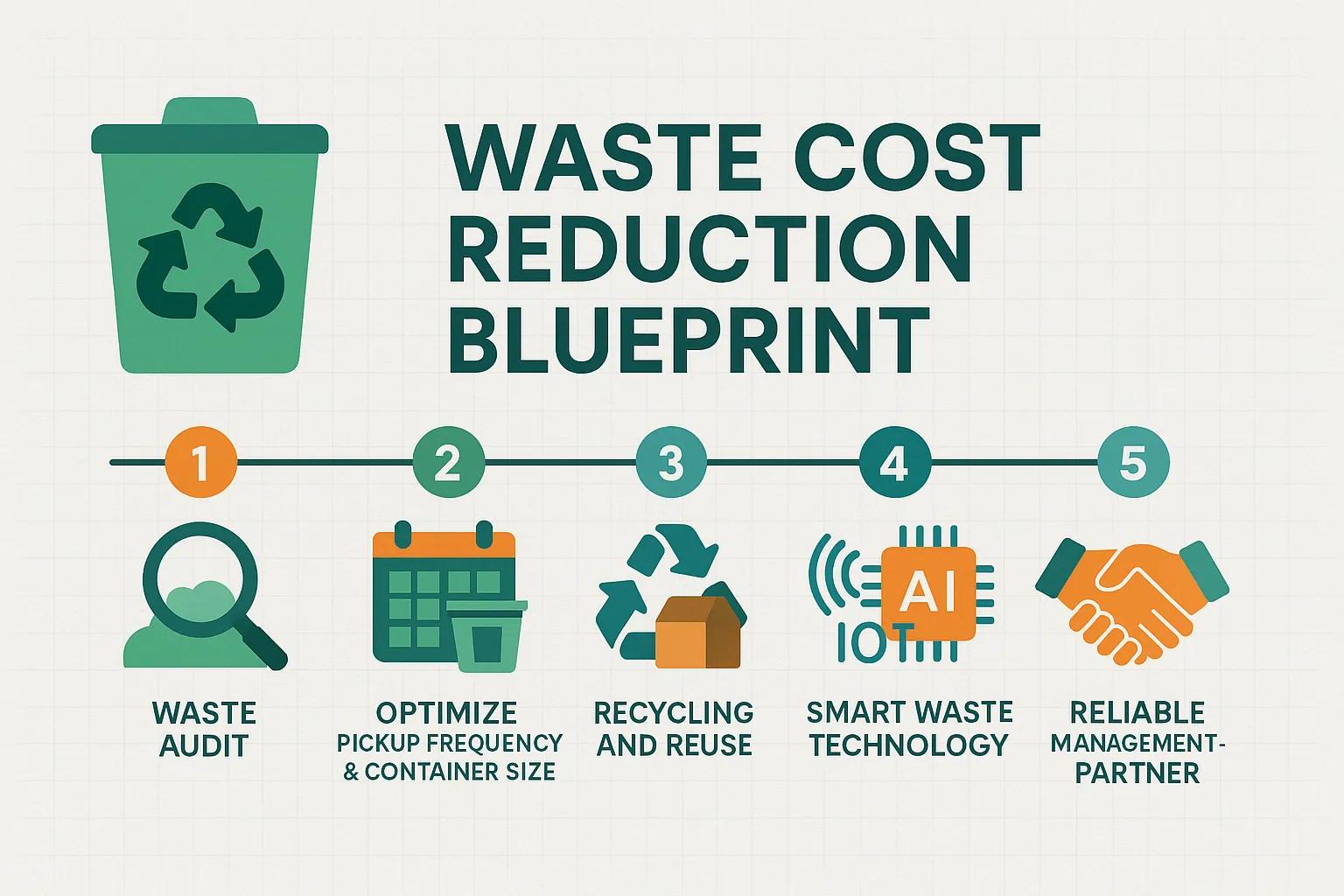
- Collect invoices and normalize line items for cross‑site comparison.
- Reconcile billed services with contracted frequencies and equipment counts.
- Flag discrepancies and pursue credits or disputes with haulers.
- Amend contracts and monitor to prevent recurrence.
That sequence recovers past errors and builds stronger billing controls. The compact table below maps common auditing tactics to typical findings and the average savings each can deliver.
Introductory note: The table below compares common cost‑reduction tactics, typical audit findings, and indicative savings to illustrate tangible outcomes from systematic auditing and optimization .
| Tactic | Typical Finding | Average Savings (%) |
|---|---|---|
| Invoice auditing | Duplicate charges, incorrect rates | 8–20 |
| Dumpster right-sizing | Oversized containers, unnecessary pickups | 5–12 |
| Vendor consolidation | Multiple small contracts with varied pricing | 3–10 |
Layering auditing, right‑sizing, and consolidation produces better, sustained reductions in total waste spend than one‑off fixes.
What Role Does Invoice Auditing Play in Waste Cost Reduction?
Invoice auditing checks billed services against contracts and actual pickups, reconciling line‑item detail to expose errors and recovery opportunities. Typical findings include duplicate charges, misapplied taxes, incorrect frequencies, and billing for missed services—issues that scale into persistent cost leakage. A recurring audit cycle both recovers credits and strengthens controls to reduce future anomalies. Audits normally follow a workflow of data ingestion, normalization, exception identification, dispute resolution, and remediation, which also yields KPIs for vendor performance monitoring .
A disciplined audit program becomes negotiation leverage: billing anomalies turn into reasons to secure better rates or service commitments. Even modest percentage recoveries add up across hundreds or thousands of locations, making routine audits a core financial control for multi-site operators .
How Does Optimizing Commercial Dumpster Usage Lower Expenses?
Dumpster optimization aligns container sizes, pickup frequency, and routing with actual waste generation so hauling costs and equipment investments are minimized. The mechanism is utilization matching: right‑sizing and frequency adjustments eliminate unnecessary pickups and reduce per‑ton hauling charges. Benefits include fewer pickups, lower haul fees, longer equipment life, and steadier operations for site teams.
Practical tactics include utilization audits, shared containers for adjacent sites where practical, and dynamic routing during peak seasons to avoid emergency rates. Paired with invoice auditing and vendor negotiations, dumpster optimization provides ongoing downward pressure on total waste costs.
What Sustainable Commercial Waste Management Solutions Does NWA Offer?
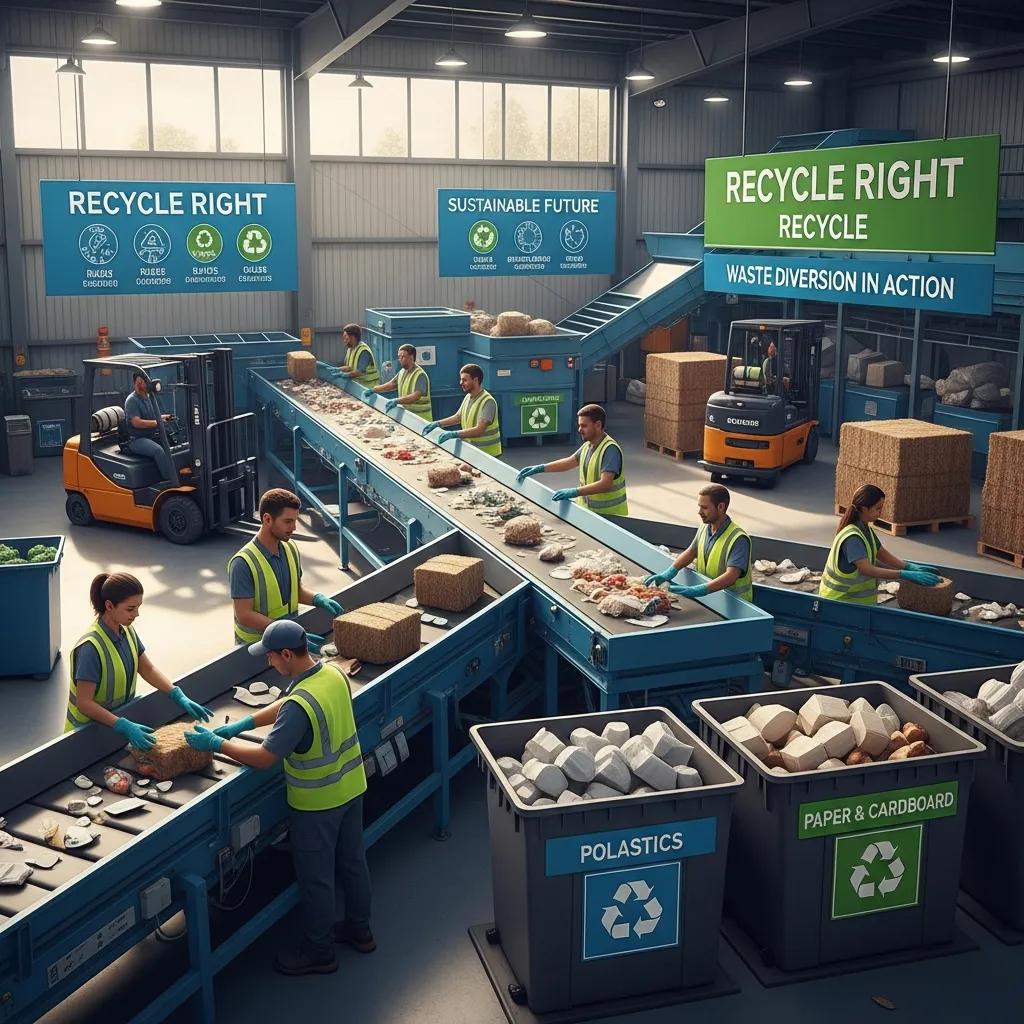
Sustainable commercial waste management covers recycling programs, zero‑waste initiatives, diversion tactics, and measurement frameworks that support ESG commitments while often lowering disposal costs. Sustainability programs work by segregating waste streams and aligning processing with market demand: separating recyclables and organics at the source and directing them to appropriate processors reduces landfill volumes and can recover value from materials. Benefits include lower landfill fees, better public perception, and measurable diversion metrics for sustainability reporting.
Core program elements include source separation standards, employee training, contamination control, and KPI‑driven monitoring. Best practices pair operational changes—optimized bin placement and clear signage—with contracts that secure processing capacity and end‑market access. The subsections below cover zero‑waste program benefits and practical recycling and diversion steps.
Introductory list: Key sustainability program components enterprises should consider include operational controls, vendor partnerships, measurement, and continuous improvement.
- Source separation standards and clearer signage to reduce contamination.
- Partnerships with processors or brokers that accept segregated streams.
- Data tracking of diversion rates, contamination, and cost per ton.
Together, these elements turn sustainability goals into measurable programs that can also lower net waste costs.
How Do Zero Waste Programs Benefit Large Businesses?
Zero‑waste programs seek to divert the bulk of material from landfills through reduction, reuse, recycling, and recovery. They restructure material flows and supplier partnerships to reduce disposal volume. Immediate benefits include lower landfill costs and easier compliance with emerging rules; longer‑term gains include a stronger brand story and richer sustainability reporting. National Waste Associates has helped clients target diversion rates above 90% in focused programs—showing what’s possible with disciplined design. Zero‑waste efforts require initial investments in segregation, training, and processing relationships, but those expenses are often offset over time by lower disposal fees and recovered material value.
When organizations embed zero‑waste practices into procurement, operations, and vendor selection, suppliers and partners begin to align, amplifying both cost and environmental benefits .
What Are Best Practices for Commercial Recycling and Waste Diversion?
Successful recycling and diversion rest on program design, contamination prevention, processing partnerships, and KPI monitoring—diversion rate and contamination percentage being key metrics. The operational engine is discipline: clear collection streams, consistent signage, and targeted staff training reduce contamination and raise material quality. The result is higher‑value recyclables, less disposal, and stronger ESG outcomes.
A practical rollout checklist includes baseline waste audits, pilot programs at representative sites, staff training, and scheduled KPI reviews .
- Conduct baseline waste audits to identify major streams and contamination hotspots.
- Pilot segregated collection at a sample of sites before scaling across the portfolio.
- Train staff and use consistent labeling to reduce contamination.
Regular monitoring and iterative adjustments based on KPI trends keep programs effective and scalable.
How Does NWA Ensure Compliance with Commercial Waste Regulations?
Compliance requires centralized tracking of state and local rules , site audits, coordinated permitting, and a remediation workflow that addresses violations quickly to limit fines and disruption. The mechanism is proactive oversight: assigning responsibility for regulatory monitoring and embedding compliance checks into daily operations reduces exposure to penalties and service interruptions. Benefits include steadier operations, reduced regulatory risk, and documented evidence of adherence for inspections. The subsections that follow outline common state‑level rule categories and how an in‑house compliance manager supports multi‑site compliance.
Introductory note: The table below maps regulation types to typical compliance risks and mitigation approaches to help multi‑location operators prioritize oversight .
| Regulation Type | Compliance Risk | Mitigation Approach |
|---|---|---|
| Recycling mandates | Non‑compliance fines, diversion shortfalls | Standardized diversion procedures and reporting |
| Landfill bans (organics) | Illegal disposal, route changes | Local routing and processor agreements |
| Hazardous waste rules | Significant penalties, site shutdowns | Centralized permitting and staff training |
What Are Key State-Specific Waste Laws Affecting Multi-Location Businesses?
Key state laws include extended producer responsibility programs, organics landfill bans, municipal recycling mandates, and state‑specific hazardous waste definitions. These rules affect collection, processing, and recordkeeping—sometimes requiring separate streams or limiting disposal options—which in turn forces contract and hauler adjustments. Knowing state‑by‑state requirements lets you design compliant service models and avoid costly missteps. Practical steps include keeping a centralized rule matrix, assigning regional points of contact, and embedding rule checks into procurement and vendor selection.
Start rollout in the most regulated jurisdictions to build compliant templates that can be adapted elsewhere.
How Does In-House Compliance Management Support Regulatory Adherence?
An in‑house compliance function centralizes legal monitoring, coordinates permit renewals, audits site practices, and acts as the liaison with haulers and regulators to resolve issues quickly. The advantage is institutional memory and consistent processes: a dedicated manager tracks changes, standardizes documentation, and leads remediation when inspections or discrepancies occur. Benefits include lower regulatory exposure, faster issue resolution, and uninterrupted operations . A simple compliance workflow includes monitoring, site audits, corrective action plans, and archived documentation for inspection readiness.
This capability pairs well with centralized data systems that capture pickup logs, manifests, and inspection records, creating an auditable trail that demonstrates due diligence .
How Does the NWA360 Client Portal Enhance Efficiency in Waste Vendor Management?
NWA360 is a client portal that centralizes data, offers 24/7 access to tailored reporting, and simplifies vendor coordination by bringing invoices, pickup records, and performance KPIs into a single platform. The platform’s value is transparency and centralized control: invoice exceptions, pickup histories, and regional benchmarks surface quickly so disputes are resolved faster and vendor decisions are data‑driven. Benefits include clearer spend visibility, streamlined vendor workflows, and reports that support finance and sustainability teams. The following table highlights representative NWA360 features and example outcomes for multi‑location clients .
Introductory note: The table below highlights representative NWA360 features, the benefits they deliver, and an example data point that illustrates potential outcomes for multi-location clients.
| Feature | Benefit | Example Data Point |
|---|---|---|
| Custom dashboards | Rapid visibility into spend by region | Savings by region summary |
| Invoice-level visibility | Faster dispute resolution | 30‑day reduction in dispute cycle |
| KPI tracking | Benchmarking across locations | Diversion rate comparisons |
What Features Provide Transparency and Customized Reporting?
Transparency features include custom dashboards, scheduled and ad‑hoc reports, invoice‑level drilldowns, and exception reporting that flags anomalies. These tools create a single source of truth for multi‑site waste operations. Dashboards aggregate disparate data into contextual views so finance, operations, and sustainability teams can act on exceptions and trends. The result is less time resolving billing disputes, better informed contract negotiations, and clearer progress toward diversion targets. Typical reports include regional spend summaries, pickup frequency heatmaps, and savings opportunity reports to guide enterprise decisions.
Centralizing reporting replaces scattered spreadsheets with standardized visualizations that improve cross‑functional collaboration and make optimization repeatable across sites.
How Does NWA360 Streamline Hauler Coordination Across Locations?
NWA360 streamlines hauler coordination by consolidating vendor data, maintaining a curated hauler database, and supporting centralized scheduling and performance tracking to reduce friction between sites and providers. Standardized workflows—central vendor assignments and route optimization—cut redundant relationships and set uniform service expectations at each location. Benefits include fewer service escalations, stronger contract adherence, and the ability to aggregate volume for better pricing. For example, centralized scheduling can combine adjacent site pickups into optimized routes that lower fuel and labor costs while keeping service windows intact.
This coordinated approach, combined with ongoing performance tracking, ensures vendor selection and routing decisions are guided by historical reliability and cost data for continuous improvement across the enterprise.
Frequently Asked Questions
What are the benefits of using a centralized client portal for waste management?
A centralized client portal like NWA360 gives you real‑time access to data, tailored reporting, and simplified vendor coordination. That transparency helps teams monitor spend, track performance, and resolve billing disputes faster. Consolidating information in one place makes it easier to optimize collection schedules and meet sustainability goals—delivering better operational efficiency and cost savings across multiple locations.
How can businesses ensure compliance with varying local waste regulations?
To stay compliant across jurisdictions, implement centralized regulatory monitoring that tracks state and local laws, conduct regular site audits, maintain a rule matrix, and assign regional compliance contacts. Integrate compliance checks into daily operations and train staff on local requirements. Proactive management of legal changes reduces the risk of fines and service interruptions and keeps operations running smoothly .
What strategies can help improve recycling rates in multi-location businesses?
Raise recycling rates by enforcing clear source separation policies, running regular waste audits, and training employees. Partner with processors that accept segregated streams and use consistent signage and accessible bins to reduce contamination. Track KPIs—diversion rates and contamination levels—to measure program performance and guide targeted improvements. successful recycling program
How does vendor consolidation impact waste management costs?
Vendor consolidation reduces costs by simplifying contracts and leveraging volume for better pricing. Fewer vendors mean less administrative overhead and clearer service standards, which improves consistency across sites. Consolidation also enables stronger negotiations and easier management of performance and compliance, lowering total disposal costs .
What role does employee training play in effective waste management?
Employee training is essential. Clear training reduces contamination, increases participation in recycling programs, and ensures compliance with local rules. Regular refreshers and practical guidance help staff make the right disposal choices, which boosts diversion rates and supports overall program success.
What are the key components of a successful zero waste program?
A successful zero‑waste program combines waste reduction strategies, source separation, employee engagement, and partnerships with recycling and composting providers. Set measurable diversion goals, train staff, and monitor progress with KPIs. Collaborating with suppliers and stakeholders helps scale impact and maximize material recovery.
How can businesses measure the success of their waste management initiatives?
Measure success with KPIs like diversion rate, contamination percentage, and cost per ton disposed. Regular audits and data analysis reveal efficiency gains and opportunities for improvement. Set clear, measurable goals and review progress often—using data to refine tactics and demonstrate outcomes over time.
Conclusion
Aligning a national waste strategy with local collection services delivers clearer operations, lower costs, and stronger sustainability outcomes for multi‑location businesses. By mapping regulations, optimizing vendors and containers, and using centralized data and compliance controls, organizations can achieve measurable improvements in both cost and diversion. These best practices support long‑term financial and environmental goals—if you’d like, our team can show how tailored solutions and the NWA360 platform streamline waste management across your sites.
About the author