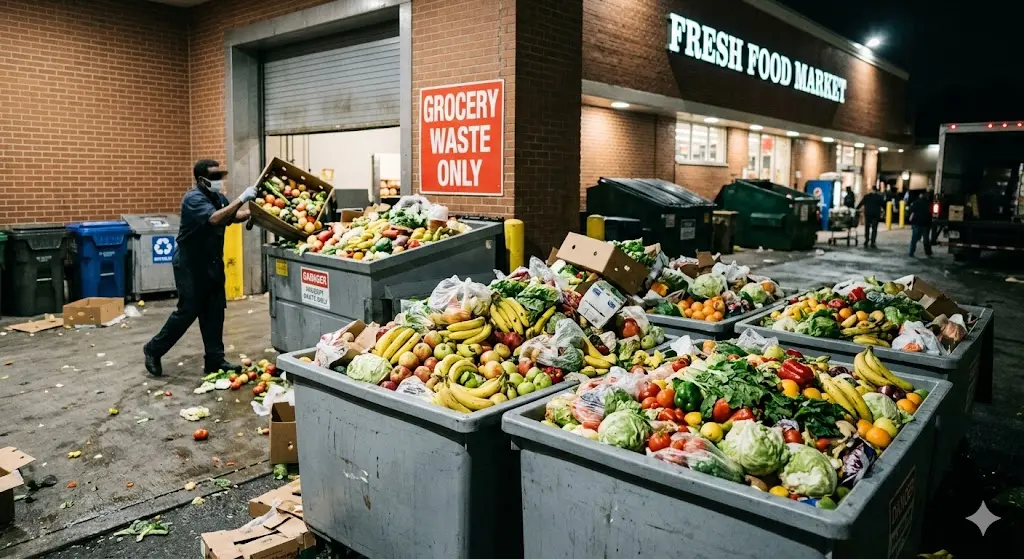
Food waste is no longer just a “green” initiative—it’s a massive business opportunity. As of 2026, global food waste costs are projected to reach $540 billion annually. For grocery retailers, this waste isn’t just rotting produce; it’s a direct hit to margins, equivalent to roughly 33% of total revenue across the supply chain.
In this guide, we’ll explore why food waste happens at the retail level and the innovative 2026 strategies grocery stores are using to turn “trash” into profit.
Why Grocery Stores Waste So Much Food
While many assume food waste is purely a consumer problem, retailers generate over 4 million tons of waste every year. The primary drivers include:
- Visual Overstocking: To meet consumer expectations of “abundance,” stores often overfill produce bins, leading to bruising and faster spoilage.
- Decentralized Planning: Outdated, manual ordering processes mean stores often order too many of the wrong items, especially during holiday surges.
- The “Meat Challenge”: Meat waste alone is expected to cost the industry $94 billion in 2026, making it the single most expensive category to manage.
2026 Strategies for Waste Reduction
Recent research published in Management Science shows that retailers can cut waste by more than 21% without expensive new tech, simply by changing operational habits.
1. Smarter Shelf Positioning
Instead of burying older items, retailers are adopting “dynamic shelf placement.” By moving items nearing their expiration dates to eye-level or the front of the display and pairing them with slight discounts, stores can increase profits by 6% while significantly reducing spoilage.
2. The Rise of “Upcycled” Products
2026 is the year of upcycled functionalism. Grocery stores are increasingly stocking products made from “industrial leftovers.”
- Spent Grain: Repurposed into high-fiber flours.
- Fruit Pulp: Used as natural colorants or thickeners in snacks.
- Cacao Pulp: Transformed into high-value functional ingredients.
3. AI-Driven Inventory Management
Leading retailers are now using AI for predictive shelf-life monitoring. These systems use real-time data to adjust ordering based on weather patterns, local events, and historical demand, preventing the “over-ordering” trap.
The Environmental Impact
The stakes go beyond the bottom line. According to a 2026 study in Nature Climate Change, food waste accounts for 19% of global greenhouse gas emissions.
“Methane released when food rots in landfills is roughly 80 times more potent than CO2 over a 20-year period.” — Nature Climate Change, 2026
| Waste Metric (2026) | Impact |
|---|---|
| Global Cost | $540 Billion |
| US Waste Volume | 60 Million Tons |
| GHG Emissions | 4.0 Gigatons CO2e |
| Average HH Waste | $1,500 - $1,800/year |
Frequently Asked Questions (FAQ)
How much food does the average person waste?
In the US, the average person wastes about 325 pounds of food annually, which is roughly equivalent to throwing away one entire meal every day.
What is “zero-waste” grocery shopping?
It involves habits like using reusable produce bags, buying from bulk aisles with glass jars, and avoiding pre-cut or single-serve items that use excessive plastic packaging.
Do grocery stores donate their unsold food?
Many do, but Pact pilot projects have shown that the most effective way to reduce waste is to stop the surplus at the source through better demand planning.
Can technology really stop food waste?
Yes. For example, AI-driven platforms like RELEX helped prevent 350 million kilograms of food waste in 2024, the equivalent of taking 600,000 cars off the road.
About the author