Introduction: Unraveling the Concept of Circular Waste
For decades, our global economic model has operated on a linear principle: take, make, dispose. This paradigm, while fueling rapid industrial growth, has simultaneously generated an immense challenge: traditional waste. However, as we confront the realities of resource depletion, environmental pollution, and climate change, a new understanding of material flow is emerging. This shift introduces the critical concept of circular waste, a term that, paradoxically, refers to the waste generated within a system striving for circularity, or more precisely, the materials that fail to be reintegrated into the loop. It is the antithesis of the aspiration of a truly closed-loop system, representing the leakage or inefficiency.
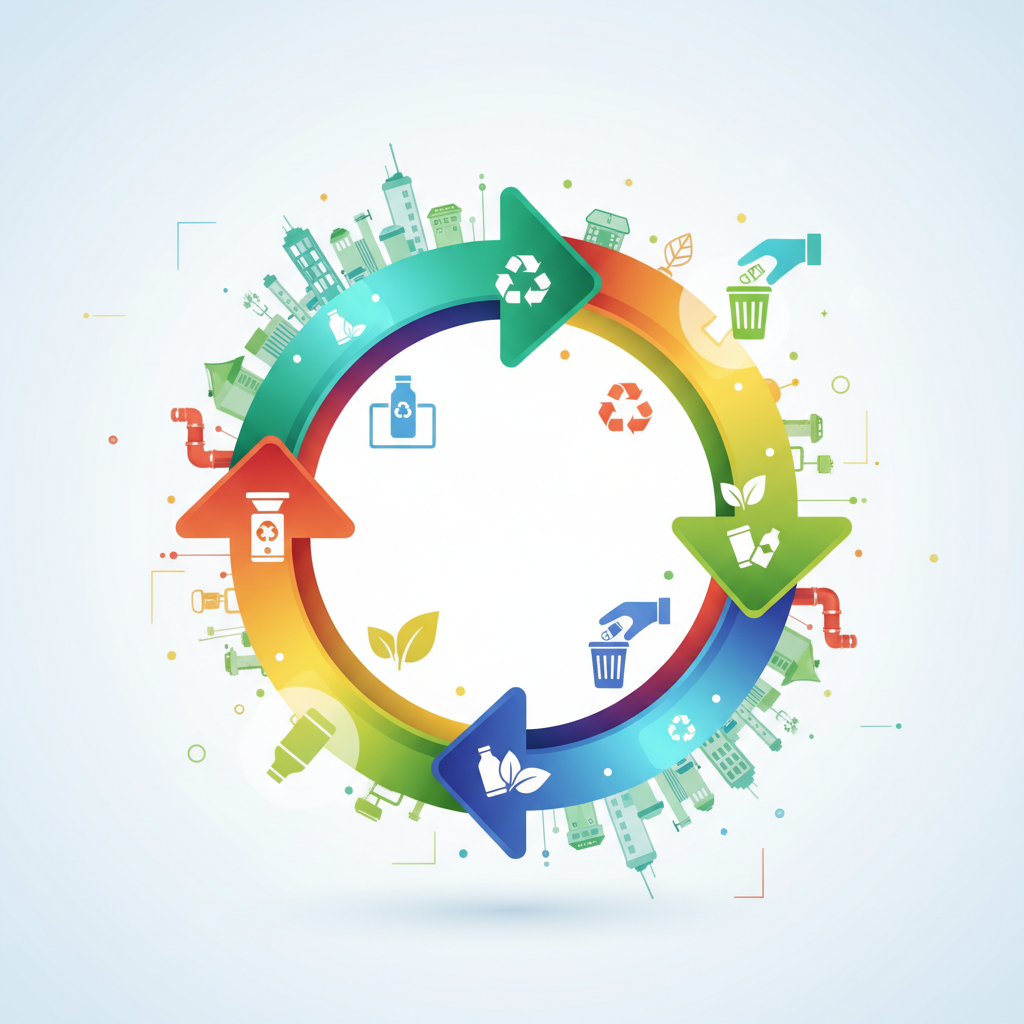
The overarching solution to minimizing circular waste lies within the principles of the circular economy. This innovative economic framework champions the redesign of products and systems to eliminate waste and pollution, keep products and materials in use for as long as possible, and regenerate natural systems. Rather than viewing discarded materials as ‘waste’ to be disposed of, the circular economy considers them valuable resources that can be continuously cycled, either as technical nutrients (non-biodegradable materials like metals and plastics) or biological nutrients (biodegradable materials that can safely return to the biosphere). Understanding and actively addressing the points at which materials exit this intended loop – forming circular waste – is paramount to achieving true sustainability and resilience in our global economy.
The Linear vs. Circular Model: A Paradigm Shift
To truly grasp the significance of eliminating circular waste, it’s essential to understand the stark contrast between our historical linear economic model and the aspirational circular economy. The linear model, often termed “take-make-dispose,” is characterized by an insatiable extraction of virgin resources, their transformation into products, and their eventual disposal into landfills or incinerators after a single use. This model is inherently unsustainable, leading to rapid depletion of finite natural resources, significant energy consumption, massive greenhouse gas emissions, and widespread environmental degradation, from overflowing landfills to plastic-choked oceans.
The consequences are far-reaching: geopolitical tensions over resource access, economic instability due to volatile commodity prices, and irreversible damage to ecosystems that underpin human well-being. This wasteful approach creates a substantial amount of what we might call “linear waste” – materials that are designed for obsolescence and intended for disposal from the outset. In contrast, the circular economy fundamentally rethinks this process. It envisions a regenerative system where materials are kept in continuous cycles of use, repair, refurbishment, remanufacture, and ultimately, high-quality recycling. The goal is to maximize the value and lifespan of products and components, turning potential circular waste into valuable inputs for new production cycles. This shift is not merely about better waste management; it’s a systemic transformation of how we design, produce, and consume, aimed at decoupling economic growth from resource depletion.
| Feature Linear Economy | (Take-Make-Dispose) Circular | Economy (Reduce-Reuse-Recycle-Regenerate) |
|---|---|---|
| Resource Input | Primarily virgin, finite resources | Renewable, recycled, and regenerated resources |
| Product Lifespan | Designed for obsolescence, short use phase | Designed for durability, repairability, longevity, and multiple cycles |
| Waste Management | Disposal (landfill, incineration), minimal recycling | Waste prevention, reuse, repair, remanufacturing, and high-quality recycling |
| Environmental Impact | High resource depletion, significant pollution, and high emissions | Reduced resource use, minimal pollution, lower emissions, and ecosystem regeneration |
| Economic Model | Ownership-based, transaction-focused | Service-based, performance-focused, value retention |
| Goal | Produce and sell new products quickly | Maintain product value, eliminate waste, regenerate nature |
Core Principles and Strategies for Designing Out Circular Waste
The elimination of circular waste is not an afterthought; it is an intrinsic part of the design process within a circular economy. The core philosophy centers on “designing out waste and pollution,” ensuring that products and materials retain their value for as long as possible. This goes far beyond traditional end-of-pipe recycling, embedding circularity from conception.
Key strategies include:
- Refuse & Rethink: The first and most impactful step is to question the necessity of a product or material in the first place. Can a service replace ownership? Can a product be designed to be truly multifunctional, thus reducing the need for multiple items? This involves a fundamental shift in business models and consumer behavior, moving away from single-use items and towards durable, shared, or service-based solutions.
- Reduce: Minimizing the amount of resources used in production and consumption. This can involve lightweighting products, optimizing packaging, and streamlining supply chains. Less material input naturally leads to less potential for circular waste downstream.
- Reuse: Extending the lifespan of products through direct reuse for the same purpose or a new purpose. This is exemplified by refillable packaging systems, second-hand markets, and donated goods. Reuse avoids the energy and material inputs required for manufacturing new items and significantly reduces waste generation.
- Repair & Refurbish: Designing products for easy repair and offering repair services keeps items in use longer. Refurbishment involves restoring a product to a good working condition, often replacing worn-out parts. This maintains the product’s original function and value, delaying its entry into the waste stream.
- Remanufacture: Taking a used product, typically an industrial component, and bringing it back to “like-new” condition, often with the same warranty as a new product. This requires disassembling, cleaning, inspecting, and replacing parts while leveraging the original item’s core structure.
- Repurpose: Giving a used product or material a different function than its original intent, often creatively. While not as high-value as remanufacturing, it still diverts materials from landfill and can lead to innovative new products.
- Recycle: The process of converting waste materials into new materials and objects. Within the circular economy, the emphasis is on high-quality recycling that maintains the material’s properties (often called ‘upcycling’ or ‘closed-loop recycling’) rather than ‘downcycling’, where material quality degrades over cycles. Effective recycling infrastructure and design for recyclability are critical to prevent materials from becoming circular waste.
- Recover & Regenerate: For materials that cannot be reused or recycled (typically organic waste), biological processes like composting or anaerobic digestion can recover valuable nutrients, returning them to the soil and regenerating natural systems. Energy recovery (incineration with energy capture) is a last resort for materials that cannot be otherwise cycled, but the primary focus is on material loops.
“The greatest danger to our planet is the belief that someone else will save it. The circular economy is not a distant ideal; it’s a practical framework for every designer, business, and consumer to eliminate waste at its source.” – Attributed to Ellen MacArthur
By integrating these principles, businesses can transition from a linear “end-of-life” mentality to a circular “end-of-use” framework, where resources are perpetually cycled, and the generation of true circular waste becomes increasingly minimal.
Technological Innovations Powering the Circular Transition
The aspiration to eliminate circular waste and fully embrace the circular economy is being significantly propelled by advancements in technology. These innovations are not only making circular practices more feasible but also more economically attractive across various sectors.
One of the most impactful areas is in smart sorting and recycling technologies. Traditional recycling has been hampered by inefficient manual sorting and contamination. Today, AI-powered robotics, optical sensors, and advanced material recognition systems can rapidly and accurately sort mixed waste streams, separating different types of plastics, metals, and papers with unprecedented precision. This drastically increases the purity of recycled materials, making them viable inputs for high-quality new products and thus preventing them from becoming circular waste.
Material science breakthroughs are also fundamental. Researchers are developing new generations of bio-based and biodegradable plastics that can break down safely into natural systems, addressing the pervasive issue of plastic pollution. Innovations in composite materials allow for easier disassembly and separation of components, facilitating repair and recycling. Self-healing materials, designed to repair minor damage automatically, extend product lifespans significantly, pushing back the point at which they might become circular waste.
 Digital platforms and the Internet of Things (IoT) play a crucial role in enabling circular business models. Product-as-a-service models, where companies retain ownership of products and lease their functionality, are facilitated by IoT sensors that monitor product performance, predict maintenance needs, and track usage. Blockchain technology is emerging as a powerful tool for creating transparent and traceable supply chains, allowing consumers and businesses to verify the origin, composition, and circularity of materials, making it easier to identify and manage potential circular waste streams. Sharing economy platforms for tools, vehicles, and clothing also maximize product utilization, reducing the need for new purchases and extending product lifecycles.
Furthermore, concepts like industrial symbiosis are being scaled through digital matching platforms. These platforms connect companies that have waste by-products with other companies that can use those by-products as raw materials, effectively turning one industry’s waste into another’s resource. This creates regional networks of material exchange, dramatically reducing overall waste generation. Similarly, urban mining, which involves extracting valuable materials from discarded products and infrastructure within urban environments, is becoming more sophisticated with advanced material recovery facilities.
These technological advancements, from improved material sorting to innovative product design and digital tracking, are indispensable catalysts in moving towards a future where the concept of circular waste is increasingly an anomaly rather than an inevitability.
Policy, Regulation, and Incentives: The Framework for Circularity
While technological innovation and corporate commitment are vital, a robust policy and regulatory framework is indispensable for scaling the circular economy and effectively minimizing circular waste. Governments at local, national, and international levels have a critical role in creating an enabling environment that incentivizes circular practices and penalizes linear ones.
A cornerstone of circularity policy is Extended Producer Responsibility (EPR). EPR schemes hold manufacturers financially and/or physically responsible for the entire lifecycle of their products, including their end-of-life management. This motivates companies to design products that are durable, repairable, and recyclable, reducing the likelihood of them becoming circular waste. Examples include EPR for packaging, electronics (WEEE directive in the EU), and batteries, where producers fund collection and recycling systems.
Landfill bans and taxes are direct disincentives for waste disposal. By increasing the cost of sending waste to landfills, these policies encourage businesses and municipalities to invest in recycling, composting, and other recovery operations. Similarly, carbon pricing and taxes on virgin materials can make recycled content more economically competitive, pushing industries towards circular inputs.
Governments can also stimulate demand for circular products through green public procurement policies. By requiring government agencies to purchase products that meet specific sustainability criteria – such as containing recycled content, being repairable, or having a low carbon footprint – they send a strong signal to the market and foster the development of circular supply chains. Investment in research and development for circular technologies and materials, alongside funding for circular economy startups, further accelerates the transition.
International agreements and multilateral collaborations are also gaining traction, recognizing that material flows and pollution transcend national borders. The United Nations Sustainable Development Goals (SDGs), particularly SDG 12 (Responsible Consumption and Production), provide a global blueprint for sustainable practices, pushing nations towards circularity. Discussions around a global plastics treaty, for instance, aim to standardize definitions, promote design for circularity, and reduce plastic circular waste worldwide.
Finally, standardization and certification schemes provide benchmarks for circularity, offering transparency and building consumer trust. Labels indicating product durability, repairability scores, or recycled content empower consumers to make informed choices. By weaving these policy tools into the economic fabric, governments can systematically dismantle the linear model and construct a resilient, regenerative circular economy where the concept of circular waste is systematically engineered out of existence.
Industry Spotlight: Real-World Applications of the Circular Economy
The theoretical framework of the circular economy is being translated into tangible, impactful applications across a diverse range of industries. These real-world examples demonstrate how businesses are redesigning processes, products, and even their core models to minimize circular waste and maximize resource value.
In the textile and fashion industry, historically one of the most wasteful, circularity is gaining ground. Fast fashion’s linear model results in vast amounts of clothing becoming circular waste after minimal use. Circular strategies include designing garments for durability and repair, offering rental and subscription services for clothing, and developing advanced fiber-to-fiber recycling technologies. Brands are experimenting with take-back schemes, where old clothes are collected and either resold, repaired, or broken down to create new fibers. Innovations in material science are also exploring textiles made from recycled content or biodegradable fibers.
 The electronics sector faces a massive challenge with e-waste, a complex stream of valuable materials often containing hazardous substances. Circular approaches here include modular design, allowing easy upgrades and repairs of components (e.g., Fairphone). Companies are also implementing robust refurbishment and remanufacturing programs for devices, extending their lifespan and reducing the need for new raw materials. Material recovery facilities are employing advanced techniques to extract precious metals and rare earth elements from discarded electronics, preventing these valuable resources from becoming permanent circular waste.
Packaging is another area seeing radical transformation. The shift away from single-use plastics is driving innovation in reusable and refillable packaging systems, particularly in food and beverage. Businesses are investing in durable containers that can be sanitized and refilled multiple times. For unavoidable single-use situations, compostable and biodegradable packaging alternatives are being developed from agricultural by-products, ensuring that even if discarded, they return nutrients to the earth rather than generating persistent circular waste.
In the construction industry, circularity involves treating demolition waste not as rubble, but as a source of valuable materials. This includes salvaging bricks, timber, and steel for reuse in new builds. The concept of “material passports” is gaining traction, cataloging the materials used in a building to facilitate their recovery and reuse when the building reaches its end of life. Companies are also developing low-carbon concrete and other building materials from industrial by-products, reducing demand for virgin resources and minimizing waste.
These industry-specific examples illustrate that the circular economy is not merely a theoretical concept but a practical, economically viable approach that can drastically reduce circular waste and foster a more sustainable future across global supply chains.
The Consumer’s Role in Minimizing Circular Waste
While industry and government play pivotal roles in shaping the circular economy, the individual consumer holds immense power in driving demand and participating directly in reducing circular waste. Every purchasing decision, usage habit, and disposal choice contributes to the overall material flow within our economy. Empowered consumers can accelerate the transition from a linear to a circular system.
The most fundamental consumer action is conscious consumption. This involves critically evaluating purchases: “Do I truly need this?” “How long will it last?” “Where did it come from, and where will it go?” Opting for durable, high-quality products over cheap, disposable ones immediately reduces the likelihood of premature obsolescence and the generation of circular waste. Supporting brands committed to circular practices, transparent supply chains, and ethical labor is a powerful way to vote with one’s wallet.
Active participation in the sharing and rental economy is another significant contribution. Instead of owning items used infrequently (e.g., power tools, specialized kitchen appliances, formal wear), consumers can rent them, borrow them from libraries of things, or participate in sharing platforms. This maximizes the utilization rate of products, extending their useful life and reducing the overall material footprint of society.
Embracing a repair culture is essential. Rather than immediately replacing a broken item, consumers can seek out repair services, learn basic DIY fixes, or participate in “repair cafés.” Designing products for repairability is gaining traction, but consumer demand for such products and services reinforces this trend. This directly combats the throwaway culture that fuels circular waste.
Proper sorting and recycling practices at home remain crucial. Even in a perfectly circular world, some materials will reach their end-of-use. Understanding local recycling guidelines, cleaning recyclables, and separating organic waste for composting ensures that valuable materials are diverted from landfills and can re-enter the production loop. Inaccurate sorting can contaminate recycling streams, leading to materials being deemed unrecyclable and thus becoming circular waste.
Finally, advocacy and engagement amplify individual actions. Consumers can demand clearer labeling on product circularity, push for better municipal recycling infrastructure, and advocate for policies that support the circular economy. By collectively expressing a preference for circular products and services, consumers send a clear signal to businesses and policymakers, driving systemic change.
Here are actionable steps for consumers:
- Choose Durability: Invest in high-quality, long-lasting products designed for repair and longevity.
- Repair Before Replacing: Fix broken items whenever possible. Support local repair shops.
- Reduce & Refuse: Minimize unnecessary purchases, opt for reusable items over single-use, and say no to excessive packaging.
- Borrow, Share, Rent: Utilize sharing economy platforms and rental services for infrequently used items.
- Buy Second-Hand: Extend product lifespans by purchasing used goods and donating/selling items you no longer need.
- Recycle Correctly: Understand local recycling rules and sort waste diligently to avoid contamination.
- Compost Organics: Separate food scraps and garden waste for composting to return nutrients to the earth.
- Support Circular Businesses: Patronize companies that demonstrate clear commitments to circular design, ethical sourcing, and waste reduction.
- Advocate: Use your voice to demand more sustainable options from brands and better infrastructure from local governments.
Measuring Success and Overcoming Challenges
Transitioning to a full-fledged circular economy, free from significant circular waste, is a complex endeavor that requires robust measurement and a pragmatic approach to overcoming inherent challenges. Without clear metrics, progress cannot be tracked, and effective strategies cannot be developed.
Measuring circularity involves more than just waste diversion rates. Key metrics include material efficiency (how much value is extracted from each unit of material), resource productivity, recycled content rates in new products, product lifespan extension through repair and remanufacturing, and the share of renewable energy in production processes. Indicators tracking greenhouse gas emissions avoided by circular practices and biodiversity impact assessments also provide a holistic view. The European Union, for example, has developed a monitoring framework for the circular economy, including indicators on self-sufficiency of raw materials, waste generation per capita, and trade in secondary raw materials.
Despite growing momentum, several significant challenges persist:
- Scaling Solutions: Many circular initiatives remain niche. Bringing circular products and services to a mass market requires significant investment, infrastructure development, and logistical prowess. The transition from linear, well-established supply chains to new, circular ones is economically and operationally complex.
- Behavioral Change: Both consumer and business behaviors are deeply entrenched in the linear model. Shifting mindsets towards ownership of utility rather than product, valuing repair over replacement, and prioritizing sustainability over immediate convenience requires sustained effort in education, awareness, and incentive creation.
- Economic Viability: In many cases, virgin materials are still cheaper than recycled or secondary raw materials, due to subsidies, economies of scale in extraction, and the externalities of waste not being fully priced in. This makes it challenging for circular businesses to compete on cost alone. Policy levers like taxes on virgin materials or subsidies for circular processes are often needed.
- Policy Alignment and Harmonization: Regulatory frameworks across different regions and countries are often not aligned with circular principles, creating barriers to the international trade of secondary raw materials or to the scaling of circular business models. A fragmented policy landscape makes it difficult for global companies to implement consistent circular strategies.
- Data Collection and Transparency: Accurate data on material flows, product lifecycles, and waste streams is often lacking, making it difficult to identify leakage points (where circular waste occurs) and measure the true impact of circular interventions. Enhanced transparency and standardization of data are crucial.
- Material Purity and Contamination: Maintaining the quality of materials through multiple cycles is a technical challenge. Contamination in recycling streams can degrade material properties, leading to downcycling or rendering materials unusable, thus contributing to circular waste.
Overcoming these challenges requires collaborative efforts from governments, industries, academics, and civil society. A systemic approach, combining robust policy, technological innovation, economic incentives, and behavioral shifts, is the only path to a truly regenerative circular economy where the concept of circular waste becomes a historical footnote.
Frequently Asked Questions (FAQs) About Circular Waste
What is the difference between recycling and circularity?
Recycling is a key component of the circular economy, but it is not the sole definition of circularity. Recycling focuses on processing used materials into new ones. Circularity, however, is a much broader concept that encompasses the entire lifecycle of a product: from its design (to be durable, repairable, and recyclable) to business models that prioritize reuse, repair, and remanufacturing, with recycling being the last resort for materials that cannot be kept in their original form. The goal of circularity is to eliminate circular waste entirely, whereas traditional recycling can still involve downcycling or materials eventually exiting the loop.
Why is it called “circular waste” if the goal is no waste?
The term “circular waste” refers to the materials that fail to be kept in a circular loop within the aspirations of a circular economy. While the ultimate goal of a truly circular system is to eliminate the concept of waste, in reality, inefficiencies, contamination, or design flaws mean some materials inevitably exit the intended cycles. These “leakages” from the circular flow are what we term circular waste, representing the gap between the ideal and the current practical implementation. The term highlights that even with circular intentions, waste can still occur and needs to be actively minimized.
How can businesses transition to a circular model?
Businesses can transition by adopting several strategies:
1. Redesign Products: Focus on durability, repairability, modularity, and use of recycled/bio-based materials.
2. Implement Circular Business Models: Shift from selling products to offering product-as-a-service, leasing, or subscription models.
3. Optimize Operations: Improve material efficiency, reduce energy consumption, and incorporate industrial symbiosis.
4. Establish Take-Back Programs: Create systems for collecting used products for reuse, repair, or recycling.
5. Collaborate: Partner with suppliers, customers, and even competitors to create circular ecosystems. This systemic shift helps minimize circular waste at every stage.
What are the economic benefits of a circular economy?
The circular economy offers significant economic benefits, including:
1. Reduced Raw Material Costs: By reusing and recycling, businesses reduce reliance on volatile virgin material markets.
2. New Revenue Streams: From product-as-a-service models, repair services, and selling secondary raw materials.
3. Increased Resilience: Less dependence on global supply chains for virgin resources, leading to greater stability.
4. Innovation and Competitiveness: Drives new product development, process optimization, and market differentiation.
5. Job Creation: Especially in remanufacturing, repair, and recycling sectors.
6. Reduced Waste Management Costs: By minimizing circular waste, businesses lower disposal fees.
Is a 100% circular economy achievable?
Achieving a complete, 100% circular economy is an ambitious ideal and a continuous journey rather than a finite destination. While perfect circularity might be impossible due to the laws of thermodynamics (energy degradation, some material loss), the aim is to get as close as possible by continuously minimizing the generation of circular waste and maximizing resource efficiency. Every improvement in design, every reused product, and every material successfully recycled brings us closer to a regenerative system, making the concept of waste increasingly obsolete. The pursuit of 100% circularity drives innovation and sustainable practices.
Conclusion: A Future Free from Circular Waste
The journey from a linear “take-make-dispose” economy to a regenerative circular economy is perhaps the most critical economic and environmental imperative of our time. The concept of circular waste serves as a stark reminder of the inefficiencies and ecological costs of our current systems, highlighting the materials that inadvertently escape the intended loops of value retention.
However, as this comprehensive guide has detailed, the path forward is illuminated by innovation, policy, and collective action. From intelligent sorting technologies and breakthrough material science to progressive EPR schemes and a burgeoning consumer repair culture, the tools and strategies to design out waste and pollution are increasingly within our grasp. Industries are transforming, governments are legislating, and individuals are becoming more aware of their pivotal role.
The vision of a future largely free from circular waste is not a utopian fantasy but a tangible goal achievable through sustained effort and collaboration. By embracing circular principles, we not only safeguard our planet’s finite resources and mitigate environmental damage but also unlock new economic opportunities, foster innovation, and build more resilient, equitable societies. The transformation required is systemic, but the benefits are universal and enduring. The time to build this circular future, where every material is a resource and waste is merely a design flaw, is now.

About the author