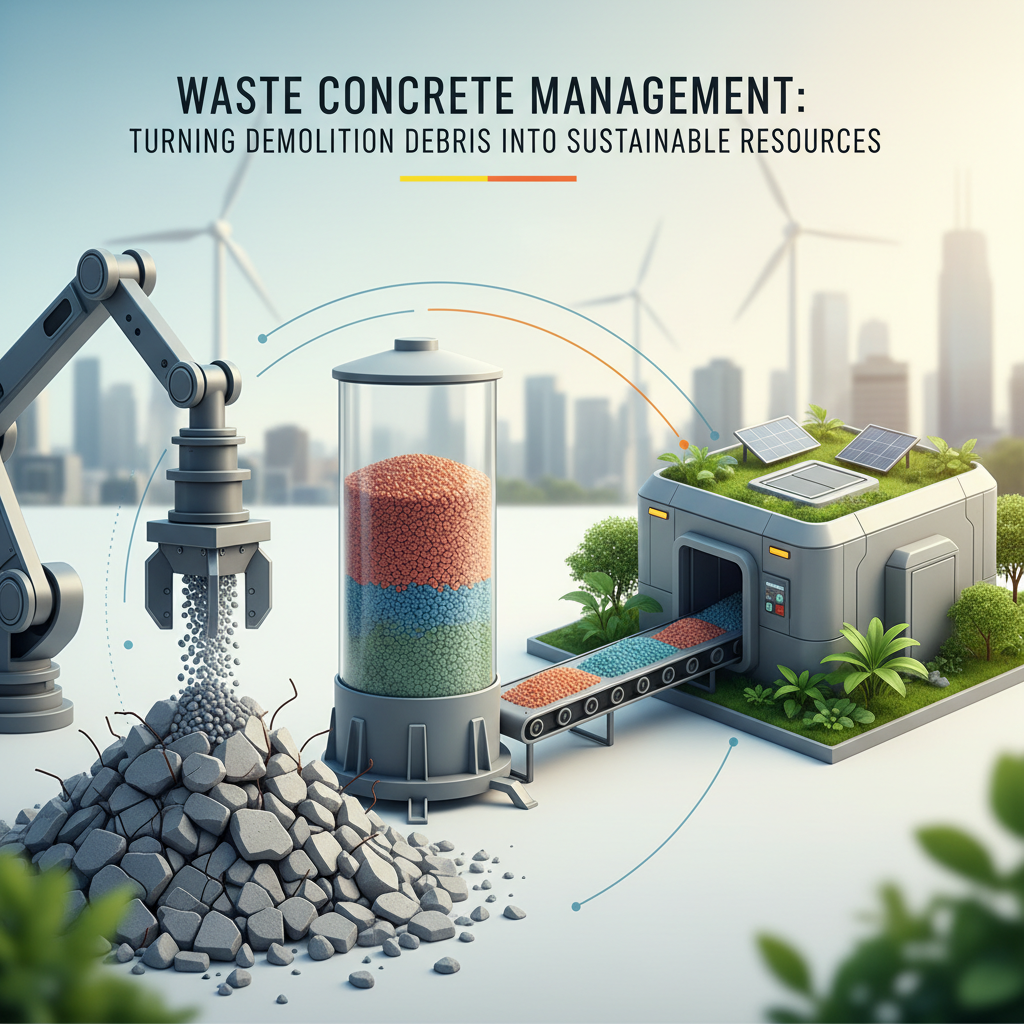
The construction industry is a cornerstone of global development, yet it generates an immense volume of waste. Among the most prevalent and challenging materials is waste concrete, a byproduct of demolition, renovation, and construction activities. As urban landscapes evolve and infrastructure ages, the sheer quantity of this material poses significant environmental and logistical hurdles. However, forward-thinking approaches are transforming this bulky debris into a valuable resource, driving the shift towards a more circular economy in construction.
This comprehensive guide delves into the challenges and innovative solutions surrounding waste concrete, highlighting its potential for sustainable reuse and recycling. We’ll explore its impact, traditional disposal methods, and the cutting-edge technologies that are reshaping its future, turning a problem into an opportunity for environmental stewardship and economic gain.
The Growing Challenge of Waste Concrete
Globally, the construction and demolition (C&D) waste stream represents a substantial portion of total waste generation. Concrete, being the most widely used man-made material, inevitably forms the largest component of this stream. Millions of tons of waste concrete are generated annually from:
- Demolition of old buildings, bridges, and infrastructure.
- Renovation projects that remove existing concrete structures.
- Construction site waste, including off-cuts, rejected batches, and spillage.
- Natural disasters, such as earthquakes and floods, which generate massive amounts of debris.
The sheer volume of waste concrete overwhelms landfills, consuming valuable land and contributing to environmental degradation. Traditional disposal is not only unsustainable but also economically inefficient, as it ignores the inherent value within the material itself.
 Understanding Waste Concrete: Sources and Characteristics
Waste concrete, also known as demolition concrete or reclaimed concrete, is essentially hardened concrete that has reached the end of its useful life in its original form. It comprises a mix of cement paste, aggregates (sand, gravel, crushed stone), and often contains reinforcing steel (rebar). Its composition makes it distinct from other construction waste materials.
Primary Sources of Waste Concrete:
- Demolition Debris: The largest source, resulting from the dismantling of buildings, bridges, and other structures.
- Renovation Waste: Generated during structural alterations or expansions where parts of concrete elements are removed.
- Construction Site Leftovers: Surplus concrete from pouring, spillages, rejected precast elements, and curing failures.
- Road & Pavement Removal: Old concrete roads and pavements are being replaced or repaired.
The quality and purity of waste concrete can vary significantly, depending on its source and the presence of contaminants like asphalt, wood, plastic, gypsum, or soil. Effective recycling processes must account for these variations.
Environmental Impact of Unmanaged Waste Concrete
Ignoring the potential of waste concrete for recycling comes with a heavy environmental price tag:
- Landfill Burden: Concrete’s density and volume rapidly consume landfill space, leading to increased pressure on land resources and potential leachate issues.
- Resource Depletion: Virgin aggregates (sand, gravel) are finite resources. Continuously extracting new materials leads to habitat destruction, erosion, and riverbed degradation.
- Energy Consumption: Producing new cement and transporting virgin aggregates requires significant energy, contributing to greenhouse gas emissions.
- Transportation Emissions: Hauling waste concrete to distant landfills and then bringing new aggregates to construction sites involves extensive transportation, increasing carbon footprints.
- Dust and Noise Pollution: Stockpiling and processing waste concrete on-site without proper controls can lead to dust dispersion and noise, impacting local communities.
“The true cost of waste isn’t just in disposal, but in the lost opportunity to reuse valuable materials and mitigate environmental harm. Waste concrete is a prime example of a resource waiting to be unlocked.”
— Global Recycling Council Report, 2022
Innovative Solutions for Waste Concrete Recycling
Fortunately, the construction industry is rapidly adopting sophisticated methods to process and reuse waste concrete. Recycling significantly reduces environmental impact and offers economic advantages.
The Recycling Process:
- Collection & Segregation: Waste concrete is collected, often at demolition sites, and separated from other contaminants (wood, metals, plastic).
- Crushing: Large pieces of concrete are fed into crushers, which break them down into smaller, manageable sizes. Jaw crushers, impact crushers, and cone crushers are commonly used.
- Screening: The crushed material is then screened to separate it into various aggregate sizes, removing fines and unwanted materials.
- Further Processing: Magnets are used to remove reinforcing steel (rebar), which can itself be recycled. Air separators or water flotation may be used for lighter contaminants.
- Quality Control: The resulting recycled concrete aggregate (RCA) is tested for properties like strength, density, and absorption to ensure it meets specifications for its intended use.
 Benefits of Recycling Waste Concrete
The benefits of transforming waste concrete into recycled concrete aggregate (RCA) are multifaceted, encompassing environmental, economic, and social advantages:
- Environmental Protection: Reduces landfill volume.
- Conserves virgin aggregate resources.
- Lowers energy consumption and greenhouse gas emissions associated with new material production and transport.
- Decreases demand for new quarries, preserving natural landscapes.
- Economic Advantages: Reduces disposal costs for demolition companies.
- Provides a cost-effective alternative to virgin aggregates, especially in areas with limited natural resources.
- Creates local jobs in recycling and processing.
- Reduces transportation costs by sourcing materials locally.
- Sustainable Construction: Supports circular economy principles, keeping materials in use for longer.
- Contributes to LEED certification and other green building standards.
- Enhances a company’s reputation for sustainability.
For more insights into sustainable building practices, explore our resources on sustainable construction materials.
Applications of Recycled Concrete Aggregate (RCA)
Recycled concrete aggregate (RCA) is a versatile material with numerous applications, proving that waste concrete can indeed find a new life:
| Common | Applications | of Recycled Concrete Aggregate Application Description Benefits of using RCA |
|---|---|---|
| Road Base & Sub-base | Used as a structural layer beneath asphalt or concrete pavements. | Excellent load-bearing properties, drainage, and cost-effective. |
| Pipe Bedding & Backfill | Supports and protects underground pipes, fills excavations. | Good compaction prevents pipe damage and uses less virgin material. |
| Embankments & Fill Material | Used to raise ground levels, stabilize slopes, or create landforms. | Reduces the need for imported fill, stable, and permeable. |
| New Concrete Mixes | As a partial or full replacement for virgin aggregates in new concrete. | Reduces demand for virgin aggregate lower embodied carbon. Requires careful mix design. |
| Gabion Walls & Revetments | Used as infill for wire mesh baskets in retaining walls and erosion control. | Durable, permeable, aesthetically pleasing, and environmentally friendly. |
| Landscaping & Drainage | As decorative stone, drainage layers, or permeable paving systems. | Effective drainage and aesthetic appeal reduce stormwater runoff. |
The American Concrete Institute (ACI) provides guidelines and standards for using RCA in new concrete, ensuring safety and performance. You can learn more about these standards on the ACI website.
 The Future of Waste Concrete Management
The trajectory for waste concrete management is towards greater innovation, efficiency, and widespread adoption of recycling. Key trends include:
- Advanced Processing Technologies: Development of more efficient crushing and sorting equipment, including robotic sorting and AI-driven quality control.
- Carbon Capture in Concrete: Research into processes that allow concrete to absorb CO2 during its lifecycle, enhancing its environmental benefits.
- High-Value Applications: Increasing use of RCA in higher-grade concrete mixes and precast products, not just as fill material.
- Modular & Deconstructable Buildings: Designing buildings for easier deconstruction, facilitating the recovery of concrete elements for direct reuse or high-quality recycling.
- Policy & Regulation: Government incentives, mandates, and stricter landfill regulations are pushing for higher recycling rates. The U.S. EPA continuously updates its guidance on the sustainable management of C&D materials.
Embracing these advancements is crucial for a sustainable future in construction.
FAQs About Waste Concrete and Recycling
Q1: Is recycled concrete as strong as virgin concrete?
A: When processed correctly and used in appropriate applications, recycled concrete aggregate (RCA) can perform comparably to virgin aggregate. For new structural concrete, RCA is often used as a partial replacement (e.g., 20-30%) for virgin aggregates, maintaining the required strength. For road bases and fill, RCA typically meets or exceeds performance requirements.
Q2: What are the main challenges in recycling waste concrete?
A: Key challenges include the presence of contaminants (e.g., asphalt, wood, plastic), the cost of transportation from demolition sites to recycling facilities, energy consumption during crushing, and overcoming historical perceptions about the quality of recycled materials. However, technological advancements and economies of scale are continually addressing these issues.
Q3: Can concrete be recycled infinitely?
A: While concrete can be recycled multiple times, the process of crushing and re-crushing can reduce the quality of the aggregate particles over time. The goal is to maximize its lifespan through various applications. For instance, once it serves as a structural aggregate, it might later be used as a road base, then potentially as general fill, extending its utility.
Q4: How does using recycled concrete affect project costs?
A: Using RCA can significantly reduce project costs, primarily by cutting down on disposal fees for demolition debris and lowering the purchase and transportation costs of new aggregates. While initial processing costs exist, the overall lifecycle costs are often lower, especially in regions with high virgin aggregate prices or limited landfill space.
Conclusion
Waste concrete, once seen as a burdensome problem, is rapidly evolving into a cornerstone of sustainable construction. By adopting advanced recycling techniques and fostering a circular economy mindset, the industry can significantly reduce its environmental footprint, conserve natural resources, and unlock substantial economic benefits. The transformation of demolition debris into high-value recycled concrete aggregate is not just an environmental imperative; it’s a smart business strategy for the future. As technology advances and regulations encourage greener practices, the potential for waste concrete to contribute to a more sustainable built environment will only continue to grow.
About the author